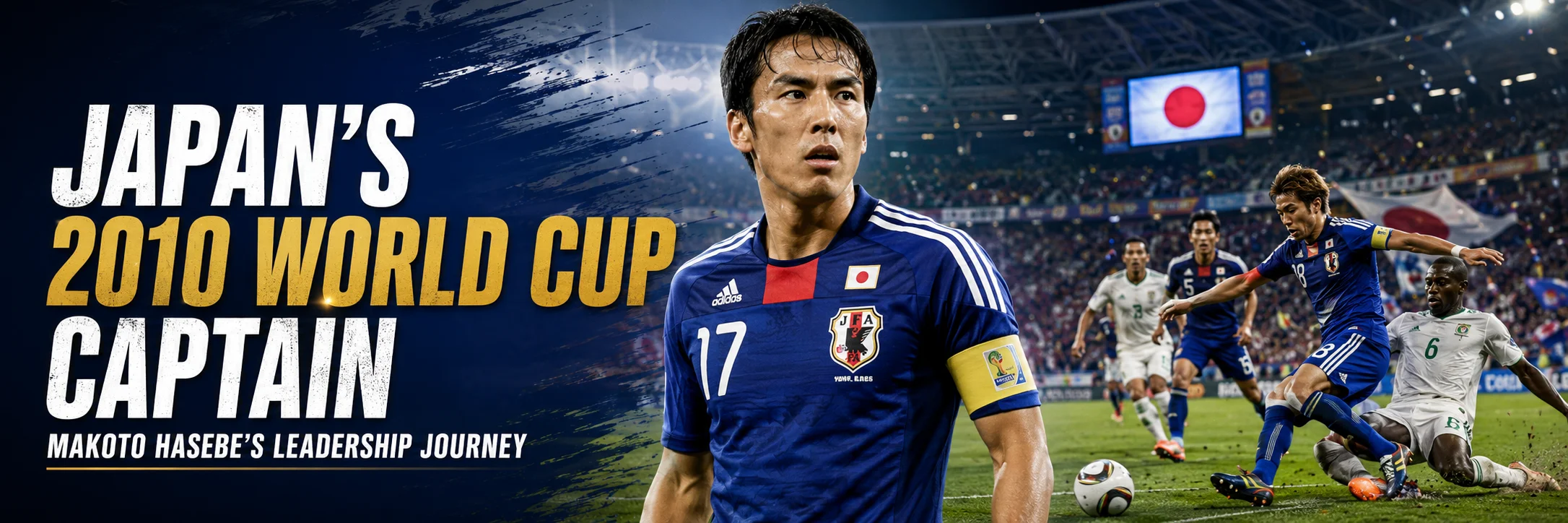
Japan's captain at the 2010 FIFA World Cup
Hasebe was 26 years old when the tournament kicked off in June 2010. He was playing club football in Germany for VfL Wolfsburg, who had just won the Bundesliga title the previous season. Coach Takeshi Okada trusted him to organise the midfield, control tempo, and be the voice on the pitch when things got tight.
He wasn't a flashy captain. No big speeches, no dramatic gestures. He was the kind of player teammates looked to when they needed someone to stay calm — and in a World Cup, that matters more than most people realise.
Japan entered the tournament with low expectations from outside. Most analysts thought the Netherlands would run away with Group E. What followed surprised everyone.
Why was Makoto Hasebe chosen as Japan's captain?
This is a question most coverage skips over, which is a shame because the answer actually says a lot about how Japan approached 2010.
Hasebe was appointed captain over Yuji Nakazawa, the veteran centre-back who had been wearing the armband before him. The switch wasn't a demotion of Nakazawa — he remained a key player and started every match — but Okada made a deliberate choice to put the captaincy in the midfield rather than the defence.
The thinking was straightforward. Hasebe controlled the tempo of play from a deep-lying position. He saw the whole pitch, read the game early, and communicated constantly. For a team built on defensive shape and quick transitions, having the captain at the base of midfield meant instructions travelled faster.
His Bundesliga experience also counted. By 2010 he had already played several seasons in one of Europe's most demanding leagues. That kind of environment — where tactical discipline is non-negotiable — shaped him into exactly the type of leader Okada needed.
His role as a defensive midfielder under Takeshi Okada
Okada set Japan up in a 4-1-4-1 shape, with Hasebe as the pivot. He sat in front of the back four, screened the defence, and recycled possession. It's not a glamorous role, but it's one that breaks down entirely if the player in it makes mistakes. Hasebe made very few.
Japan's 2010 World Cup campaign under Hasebe's captaincy
Japan were drawn into Group E alongside the Netherlands, Denmark, and Cameroon. Most pre-tournament predictions had them finishing third or fourth. They finished second, behind the Dutch.
Group stage match 1 — Japan 1–0 Cameroon
Japan's first World Cup win on foreign soil came on June 14 at the Free State Stadium in Bloemfontein. Keisuke Honda scored the only goal with a clinical finish in the 39th minute. Hasebe's job was to keep Japan compact and stop Cameroon from building rhythm through midfield — they did exactly that.
Group stage match 2 — Japan 0–1 Netherlands
The Netherlands were one of the best teams in the world that summer. Japan lost 1–0 but defended with real organisation. Giving away just one goal against a team that went on to reach the final said plenty about how well-drilled Japan were. Hasebe was central to that defensive structure all 90 minutes.
Group stage match 3 — Japan 3–1 Denmark
This was the performance that properly announced Japan at this tournament. Two stunning free kicks — one from Honda, one from Yasuhito Endo — inside the first 30 minutes effectively killed the game. Japan won 3–1 and qualified for the Round of 16 with six points from three games. A result nobody had really predicted going in.
Round of 16 — Japan 0–0 Paraguay (lost on penalties)
Japan's tournament ended in a penalty shootout against Paraguay on June 29. The match finished goalless after 120 minutes — Japan had their chances but couldn't find a winner. Yuki Abe's penalty was saved, and Paraguay went through. Hasebe played the full 120 minutes.
It was a painful exit, but reaching the knockout stage at all was considered a real achievement. And it was the last World Cup where expectations of Japan were modest.
Makoto Hasebe's captaincy legacy — three World Cups with Japan
What makes Hasebe's 2010 captaincy even more notable in retrospect is that it was just the beginning. He went on to captain Japan at the 2014 World Cup in Brazil and the 2018 World Cup in Russia — three consecutive tournaments as captain, a first for any Japanese player.
He retired from international football after Japan's Round of 16 exit against Belgium in 2018, finishing with 114 caps. That's still among the most capped players in Samurai Blue history.
At club level, his career ran even longer. He moved to Eintracht Frankfurt after Wolfsburg, became a Bundesliga institution, won the UEFA Europa League in 2022, and kept playing in the German top flight until he was 40. His final Bundesliga appearance came in May 2024, making him one of only five players ever to play in the league past that age.
The 2010 World Cup was where most international fans first noticed him. What they saw was a captain who didn't need to dominate headlines to lead effectively.
Japan's World Cup captains across all tournaments
| Year | Captain | Club (at time) | Result |
|---|---|---|---|
| 2002 | Morioka / Nakazawa | Various | Round of 16 |
| 2006 | Yuji Nakazawa | Yokohama F. Marinos | Group stage |
| 2010 | Makoto Hasebe | VfL Wolfsburg | Round of 16 |
| 2014 | Makoto Hasebe | Eintracht Frankfurt | Group stage |
| 2018 | Makoto Hasebe | Eintracht Frankfurt | Round of 16 |
| 2022 | Maya Yoshida | Schalke 04 | Round of 16 |
Frequently asked questions
Who was Japan's vice captain at the 2010 World Cup?
Yuji Nakazawa was widely regarded as the vice captain in 2010. The veteran centre-back had previously held the captain's armband himself and remained one of the most senior figures in the squad. Yasuhito Endo was another experienced leader in the group and wore the armband when Hasebe was substituted.
How many games did Makoto Hasebe play at the 2010 World Cup?
Hasebe played all four of Japan's matches — three in the group stage and one in the Round of 16. He completed every minute of every game, including extra time against Paraguay.
Who was Japan's coach at the 2010 FIFA World Cup?
Takeshi Okada managed Japan at the 2010 World Cup. He had taken charge of the national team in 2007 and led them through the qualifying campaign. Okada resigned shortly after the tournament ended, and Alberto Zaccheroni was appointed as his successor in August 2010.
Did Japan qualify from the group stage at the 2010 World Cup?
Yes. Japan finished second in Group E with six points — wins over Cameroon (1–0) and Denmark (3–1), and a narrow 1–0 loss to the Netherlands. They advanced to the Round of 16, where they lost to Paraguay on penalties.
Who won 2010 fifa world cup?
Spain won the 2010 FIFA World Cup. The tournament was held in South Africa, and Spain defeated the Netherlands 1–0 in the final on July 11, 2010. The winning goal was scored by Andrés Iniesta in extra time, giving Spain their first-ever FIFA World Cup title.


Be the first to comment!