Introduction:
Sports has always been about more than winning. It's about identity, ambition, and the way millions of people around the world connect with something bigger than themselves. But 2026 feels like a different kind of year.
The industry isn't just growing — it's being rebuilt. Faster data. Smarter training. Younger athletes competing on international stages. Digital platforms turning passive fans into active participants. The distance between a kid training in Lagos and a scout in London is shrinking faster than anyone expected.
This isn't a trend piece about what might happen someday. It's a look at what's already happening — and where the real momentum is.
The Evolution of Global Sports in 2026
The global sports industry has crossed a threshold it won't walk back from.
For most of the 20th century, sports development followed a simple geography: money flowed where TV cameras pointed, and TV cameras mostly pointed at North America and Western Europe. That's changing. Investment in sports infrastructure is spreading across South Asia, Southeast Asia, the Middle East, and Africa at a pace that would have seemed far-fetched a decade ago.
Saudi Arabia's investment in football and golf. India's cricket ecosystem driving digital revenue records. Nigeria and Kenya producing world-class distance runners and footballers with increasingly sophisticated academies behind them.
The picture is more distributed now. And that changes everything — who gets discovered, which brands matter, and which tournaments capture global attention.
Why 2026 Is a Watershed Moment
Several things are colliding at once.
The 2026 FIFA World Cup, hosted across the United States, Canada, and Mexico, is the biggest sports event in the world by viewership — and it's happening in three time zones across North America during a summer when sports consumption on mobile devices is higher than it's ever been.
At the same time, the Los Angeles Summer Olympics are less than two years away. Preparation cycles for both events are generating enormous commercial activity, from sponsorship deals to infrastructure contracts to the athlete development pipelines feeding both.
The business of sport is operating at full throttle. And the tools available to teams, athletes, and fans in 2026 are genuinely different from what existed five years ago.
AI and Technology in Modern Sports
Artificial intelligence in sports stopped being a novelty around 2022. By 2026, it's infrastructure.
Teams at the highest levels use AI for everything from injury prediction to opposition scouting to ticket pricing models. But what's more interesting is what's happening further down the pyramid — in mid-tier leagues, college sports, and youth academies where budgets are tighter but the hunger to compete is just as real.
AI tools that once required a dedicated data science team can now be accessed through platforms with clean interfaces and subscription pricing. That shift in accessibility is changing who can compete analytically.
What AI Actually Does in Sport Right Now
The practical applications aren't exotic. They're operational.
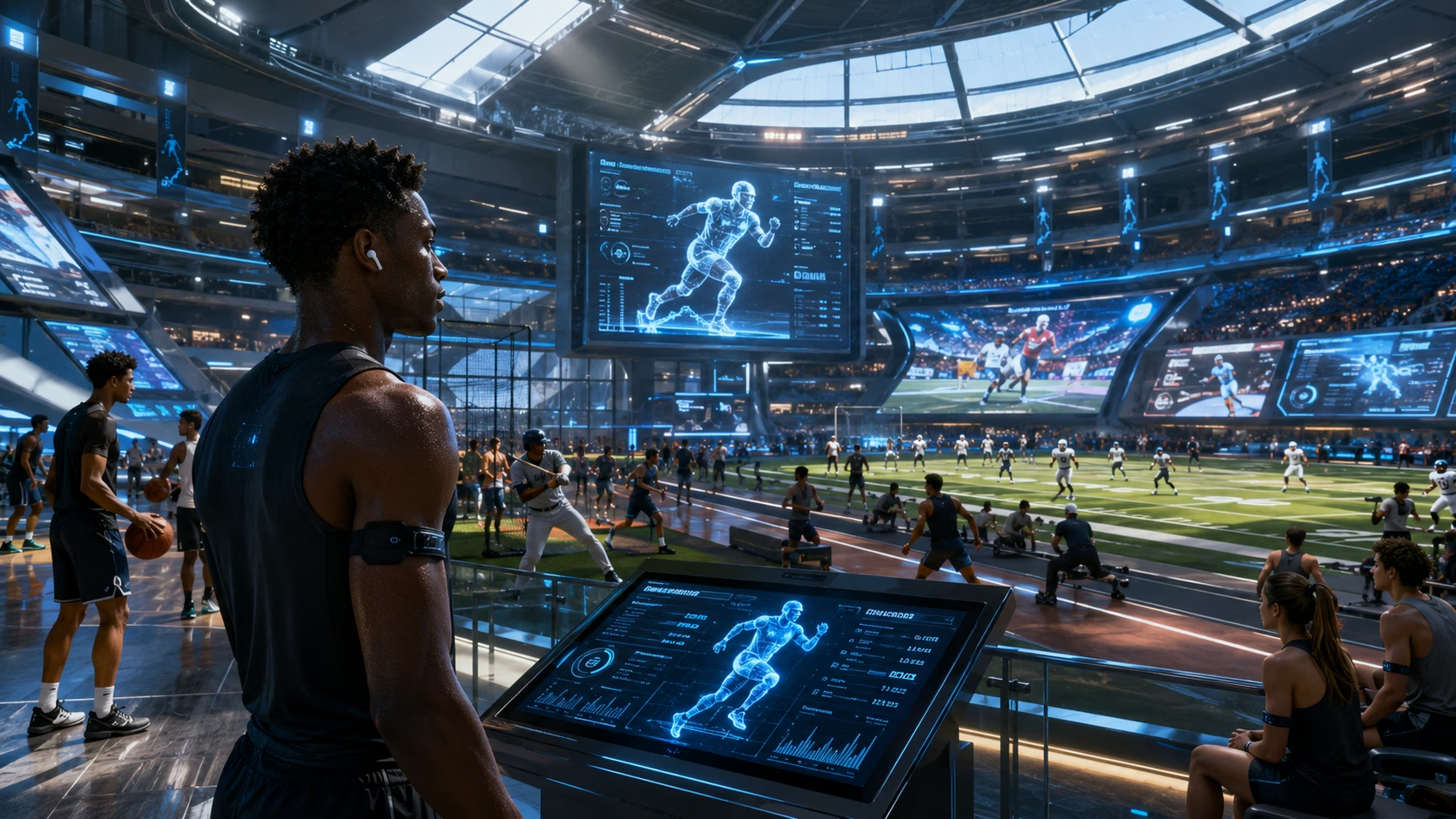
- Injury prevention: Wearable sensors collect movement data during training. Algorithms flag when an athlete's biomechanical patterns deviate from their baseline in ways that historically precede soft tissue injuries. Coaches get alerts before the problem surfaces.
- Performance modeling: GPS and accelerometer data from training sessions feed models that predict how much load an athlete can handle before performance degrades. This is especially valuable in football and basketball, where fixture congestion is a constant challenge.
- Opposition analysis: Computer vision tools process match footage to extract tactical patterns — press triggers, defensive shape, set-piece tendencies. What used to take an analyst 10 hours now takes 40 minutes.
- Recruitment: Clubs are using data aggregated from lower leagues and youth competitions to identify players whose underlying numbers suggest they're outperforming their context. Several Premier League signings in the last two seasons have come directly from models that flagged players scouts hadn't prioritized.
The gap between data-rich and data-poor organizations is closing — slowly, but closing.
The Rise of Smart Training and Athlete Analytics
Training in 2026 looks different from the outside and completely different from the inside.
The visible stuff is wearables: GPS vests, heart rate monitors, sleep trackers, and the more recent generation of inertial measurement devices that track limb velocity during strength training. These aren't new. What's new is how the data from these devices is being used.
From Data Collection to Actual Decisions
The problem with sports analytics for years was that organizations collected more data than they knew what to do with. Coaches got dashboards they didn't trust or didn't have time to interpret. The data sat in spreadsheets while decisions got made based on intuition.
That's shifted. The better platforms now translate raw data into specific, coach-facing recommendations. Not "here is the data" — but "player X is showing fatigue markers and should be managed in training tomorrow." The gap between insight and action has closed.
For individual athletes, the tools have become genuinely personal. Apps like Whoop, Catapult, and newer entrants in the space give athletes visibility into their own recovery, sleep quality, and readiness scores. High-performing athletes at every level now think about training load management the way professional cyclists have for decades.
The Mental Performance Side
One area that's gotten serious investment in the last few years is mental performance analytics. Cognitive load testing, attention tracking, and psychological readiness scores are working their way into the same dashboards that track physical metrics.
Some clubs are skeptical. The measurement methodologies aren't as settled as GPS data. But the direction of travel is clear: athlete performance is being understood holistically, not just as a physical problem.
Youth Development and International Competition
How a Global Sports Academy Is Shaping Future Athletes
The best youth academies in the world share a few things in common. They have sophisticated screening processes, science-backed training methodologies, and clear pathways from junior development through to professional competition.
What's changed in 2026 is geographic reach.
A global sports academy no longer means a European club's academy producing players for European football. It means structured development programs in countries that previously exported raw talent without developing it — and it means those programs being connected to international competition pathways from early in an athlete's career.
The Barcelona academy model has been studied and adapted across dozens of countries. The German football federation's long-term athlete development model has been replicated from Australia to Brazil. Japanese football's analytical approach to youth development, which produced a generation of technically excellent players, is influencing how clubs in Southeast Asia and the Middle East structure their programs.
The flow of knowledge has gone global, and the results are showing up in tournament results.
What the Best Youth Programs Actually Do
The gap between well-run and poorly-run youth programs isn't usually talent identification. It's what happens after you find the kid.
Well-run programs:
- Periodize training across the full calendar year, avoiding early specialization
- Monitor biological age vs. chronological age, accounting for the relative age effect
- Use psychological assessment to identify coachability and resilience
- Build international exposure into development timelines through tournaments and exchange programs
- Track individual athlete data over multi-year windows, not just season-by-season
Poorly-run programs pick the physically biggest 12-year-olds and hope some of them develop.
Why Global Sporting Events for Teens Are Growing Rapidly
Fifteen years ago, international competition for teenage athletes was largely limited to well-funded national programs in a handful of sports. That's not the world anymore.
Global sporting events for teens have expanded across disciplines, continents, and socioeconomic brackets. Youth World Championships in athletics, football, swimming, and combat sports now draw participants from countries that had no meaningful international junior program a decade ago. The IOC's Youth Olympic Games have grown in both stature and participation. Regional youth tournaments in Asia, Africa, and South America have professionalized their structures.
What's Driving the Expansion
The commercial logic is straightforward. Youth sports viewership drives long-term fan engagement. A teenager who watches their national under-17 football team compete internationally is more likely to remain a committed fan into adulthood. Broadcasters and sponsors have figured this out.
But the growth isn't only commercial. Youth sports development has become part of national soft power strategy for a growing number of countries. Hosting a junior world championship, qualifying a youth team for an international tournament, producing an Olympic medalist from a non-traditional country — these are measurable national achievements in a way they weren't considered before.
Digital platforms have also lowered the barrier to viewership. Youth sports events that wouldn't have found a broadcast deal 10 years ago now stream on YouTube and social platforms, building genuine audiences.
Digital Fan Engagement and Sports Streaming
The sports media landscape in 2026 is fragmented in ways that frustrate fans and excite investors in equal measure.
Linear TV still matters for the biggest events — World Cup finals, Super Bowls, Champions League knockouts. But the structural shift away from traditional broadcast toward streaming and digital platforms has accelerated past the point of uncertainty. It's no longer a question of whether streaming will dominate sports consumption. It does, for a large and growing portion of the audience.
What Fans Actually Want Now
The research on sports fan behavior is fairly consistent on a few points.
Younger fans consume sports differently. They don't want to watch a three-hour game from kickoff to final whistle in one sitting. They want highlights, clips, second-screen experiences, and community — often more than they want the live event itself. This isn't a failure of attention span. It's a different relationship with content.
Platforms that understand this are building products accordingly:
- Short-form content feeds (think TikTok-style highlight reels with algorithmic personalization)
- Second-screen apps that layer stats, betting odds, and social commentary over live broadcasts
- Gamification layers — prediction games, fantasy integration, interactive polls during matches
- Direct athlete content — behind-the-scenes access, training clips, personal social media — creating fan relationships that don't depend on broadcast schedules
The Fantasy Sports Explosion
Fantasy sports is no longer a niche hobby. In markets like the US, UK, and India, it's a mainstream consumption format with hundreds of millions of participants.
Fantasy cricket in India, in particular, has become one of the most commercially significant sports products in the world. Platforms like Dream11 have demonstrated that fantasy isn't just adjacent to sports — it's become a primary engagement mechanism for a generation of fans who've grown up with it.
The data loop between fantasy participation and sports viewership is a genuine feedback cycle. Fantasy players watch more games, consume more statistics content, and generate more commercial activity around sport than non-fantasy fans.
How the Global Sports Center Concept Is Changing Infrastructure
The idea of a global sports center used to mean one thing: a large, well-equipped facility in a major city where elite athletes trained.
The concept has expanded. A global sports center in 2026 is as likely to be a distributed network of connected facilities as it is a single campus. Smart training centers in multiple cities, sharing athlete data across locations, coordinated by the same coaching staff operating across time zones.
This model has practical advantages. Athletes don't have to relocate to train at the highest level. Clubs can maintain consistent methodology across multiple training bases. Data-sharing between facilities means the coaching picture of an athlete doesn't reset when they move between locations.
The physical infrastructure is changing too. Smart stadiums are standard in new builds and increasingly retrofitted into older venues. The capabilities these buildings offer — real-time crowd analytics, dynamic pricing, cashless micro-transaction infrastructure, broadcast-ready production environments built into the venue architecture — make them fundamentally different from what sports facilities were even a decade ago.
What Smart Stadium Technology Looks Like in Practice
Walk into a modern smart stadium in 2026 and the fan experience is designed with data at every layer:
- Entry systems use biometric or QR-based fast-lane access
- In-seat ordering through mobile apps, with direct delivery
- Broadcast screens synchronized with second-screen companion apps
- Dynamic seat pricing that adjusts in real-time based on demand, weather, and opponent
- Venue sensors that monitor crowd flow and adjust concession staffing dynamically
- Energy management systems that reduce operating costs significantly compared to older venues
These aren't luxury features in premium venues anymore. They're becoming baseline expectations.
What "La Surf 2009 Total Global Sport" Tells Us About Youth Sports Data
Spend enough time in youth sports analytics circles and you'll encounter a recurring challenge: the gap between what gets tracked at elite level and what gets measured in community programs.
The "la surf 2009 total global sport" framework — which references birth-year cohort tracking in youth football — reflects a broader shift toward longitudinal data in youth development. Tracking cohorts over time, understanding dropout rates, identifying which early development approaches produce durable athletes, which don't.
The insight this kind of data provides is practical. Youth sports organizations that track their own cohorts over multiple years learn things about their own programming that would never surface from season-by-season assessment alone. Which age transitions see the largest dropout? Where are girls leaving the program? What coaching approaches correlate with player retention?
This is where sports analytics is genuinely underutilized. The attention goes to elite performance. The data at grassroots level is often nonexistent or siloed. That's changing, slowly, as affordable data infrastructure becomes available to programs outside the professional tier.
Business Opportunities in the Sports Industry
The commercial side of global sports in 2026 is genuinely enormous — and still growing in areas that aren't always in the headline numbers.
Where the Growth Is
Sports technology startups are drawing serious venture capital. Performance analytics, injury prevention, fan engagement platforms, athlete management tools, coaching software — the category is broad, and the total addressable market is large. A few areas attracting particular attention:
- AI-powered coaching tools for grassroots programs
- Athlete health and longevity platforms (post-career as well as active career)
- Sports betting data infrastructure
- Digital collectibles and fan ownership mechanisms
- Youth talent identification software
Esports and traditional sports crossover has matured past the experimental phase. Major football clubs, NBA franchises, and Formula 1 teams all run competitive esports programs now. The audience overlap between traditional sports fans and competitive gaming fans is substantial — and the ability to reach younger demographics through esports formats has made it a genuine strategic priority for traditional sports organizations.
Sports media rights remain the largest single commercial category. The total value of global sports media rights contracts continues to rise. But the distribution is shifting — more fragmented, more digital, more international.
Sponsorship and brand integration have evolved past logo placement. The most commercially effective sports sponsorships in 2026 are data partnerships, platform integrations, and content collaborations rather than jersey patches. Brands want measurable engagement, not just exposure.
The Startup Ecosystem
Sports technology startups have a different risk profile than most enterprise software companies. The sales cycles are long, especially for B2B tools sold to clubs and federations. But the product validation stories are compelling — a tool that demonstrably reduced injury rates at a Premier League club is a commercial asset that sells itself.
Several accelerator programs focused specifically on sports technology have emerged in London, New York, and Lisbon. The talent pipeline is real. The funding environment has been choppy globally, but sports tech has remained more resilient than many software categories.
Future Predictions for Global Sports
Predicting technology trajectories is unreliable at the best of times, but a few directions feel well-supported by what's already in motion.
Personalization will go deeper. The fan experience — what you see, what you're offered, how you engage — will become increasingly individualized based on behavioral data. Not just "here are highlights you might like" but genuinely different products for different types of fans.
Athlete data ownership will become a commercial and ethical battleground. As the volume and value of biometric data collected from athletes grows, questions about who owns that data, who profits from it, and what athletes consent to will become serious legal and contractual issues. This is already starting.
Women's sports investment will continue to grow faster than men's. The commercial fundamentals are strong — growing audiences, undervalued media rights, brands actively seeking alignment with women's sport. The WSL, NWSL, and women's basketball globally are all in trajectories that point upward.
The African sports market will demand serious commercial attention. Population demographics, mobile-first digital consumption, and growing middle-class spending power make sub-Saharan Africa one of the most important emerging markets in global sports. It's been underserved commercially and is starting to correct.
Sports health and longevity science will reshape careers. Better understanding of injury mechanisms, recovery biology, and performance maintenance means athletes are playing longer and performing at higher levels into their 30s than was typical two decades ago. This has downstream effects on everything from contract structures to retirement planning.
Final Thoughts:
The version of global sport taking shape in 2026 is more interesting than what came before it.
More athletes from more countries competing at the highest levels. More data informing every layer of performance and business decisions. More fans engaging with sport on their own terms through digital products that didn't exist five years ago. More investment flowing into the parts of the industry — women's sport, youth development, emerging markets — that were historically undersupported.
None of this is without friction. Privacy concerns around biometric data are real. The commercialization of youth sport raises legitimate questions. Media fragmentation creates genuine problems for casual fans trying to follow the sports they love. The esports crossover generates as much skepticism as enthusiasm.
But the direction is clear. Sports is a global business ecosystem now — and the tools, infrastructure, and investment flowing into it are building something genuinely different from what existed a generation ago.
Be the first to comment!