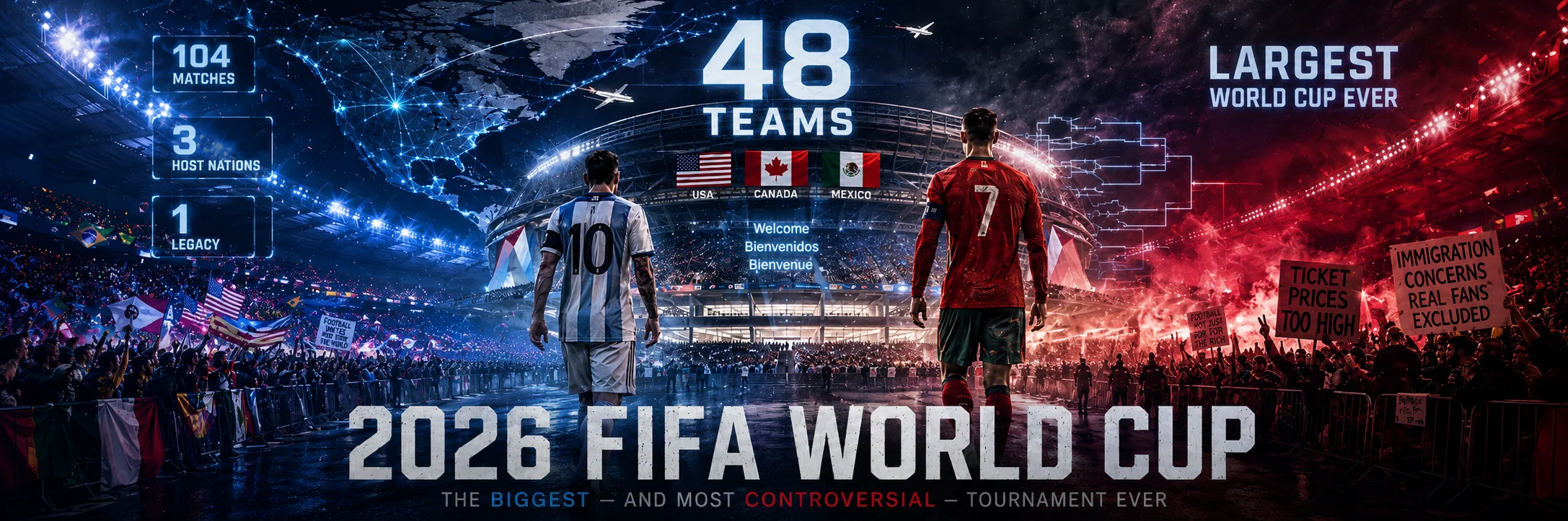
Football's biggest event is about to get much, much bigger — and much more complicated.
The 2026 FIFA World Cup launches on June 11 with a format the world has never seen before: 48 teams, 104 matches, 3 host nations, and 16 different stadiums spread across an entire continent. It is, by every measurable definition, the largest World Cup in history.
But bigger does not always mean smoother.
In the months leading up to the tournament, the 2026 World Cup has attracted controversy on almost every front — sky-high ticket prices that have locked out ordinary fans, immigration fears that are keeping international visitors away from the United States, a geopolitical standoff over Iran's participation, and a human rights warning that few major outlets have given the attention it deserves.
Meanwhile, the football itself promises something genuinely historic: four nations stepping onto the World Cup stage for the very first time, and the real possibility that Lionel Messi and Cristiano Ronaldo will both play in what is almost certainly their final tournament.
This article covers it all. The format fully explained, the controversies in depth, and everything in between — so you walk away with the most complete picture of what the 2026 World Cup really is.
From 13 Teams to 48: The Full History of World Cup Expansion
To understand why the 48-team format is such a big deal, you have to understand where the World Cup started.
When Uruguay hosted the inaugural tournament in 1930, just 13 nations participated. The competition was small by design — football was still establishing itself as a global sport, and long-distance travel made a larger tournament impractical.
From there, the expansion has been gradual but deliberate:
| Year | Teams | Total Matches | Format |
|---|---|---|---|
| 1930 | 13 | 18 | Groups + Knockout |
| 1934–1978 | 16 | 17–38 | Groups + Knockout |
| 1982–1994 | 24 | 52 | Groups + Knockout |
| 1998–2022 | 32 | 64 | 8 Groups of 4 + Knockout |
| 2026 | 48 | 104 | 12 Groups of 4 + R32 + Knockout |
Each expansion has followed a similar pattern: initial resistance from purists, followed by widespread acceptance once the tournament proved successful. The jump from 24 to 32 teams in 1998 was controversial at the time. Today, the 32-team format is remembered fondly as a golden era.
FIFA officially approved the 48-team format in January 2017, with the proposal backed by then-FIFA president Gianni Infantino. The argument was straightforward: football is growing fastest in regions like Africa, Asia, and North and Central America, and those regions deserved greater representation at the sport's biggest event.
The economic case was equally compelling. Research commissioned for the North American bid projected a gross output impact of $80.1 billion for the US economy alone — a figure that reflects stadium spending, tourism, broadcast rights, and supply chain activity across the host cities.
Arsene Wenger, now FIFA's Chief of Global Football Development, framed the expansion as "a natural evolution" of the sport. "Football is truly global now," Wenger has argued, pointing out that nearly a quarter of FIFA's 211 member associations will be represented at the 2026 tournament.
Whether you find that inspiring or alarming depends largely on how you feel about what comes next.
The 48-Team Format Fully Explained: Step by Step
Let's break down exactly how the 2026 World Cup works — clearly, completely, and without the jargon.
The Group Stage: 12 Groups of 4 Teams
The 48 qualified nations are divided into 12 groups of four teams each. Every team plays three group-stage matches, earning the standard points (3 for a win, 1 for a draw, 0 for a loss).
Why 12 groups of 4, and not 16 groups of 3?
This is one of the most important — and least-covered — decisions in the tournament's history.
FIFA's original proposal was 16 groups of 3 teams, which would have given each nation just two group-stage matches. The backlash was immediate. With only two games per group, the final match in each group would be played simultaneously by teams who already knew exactly what result they needed — a setup that's almost designed for match-fixing or agreed draws.
FIFA listened. The 12-groups-of-4 format largely mirrors what fans already know and trust, reducing the risk of manipulated results while still accommodating all 48 teams.
Who Qualifies for the Knockout Stage?
Here is where it gets slightly more complex — but it's not difficult once you see it clearly.
From the 12 groups:
- The top 2 teams in each group automatically advance (24 teams total)
- The 8 best third-placed teams across all 12 groups also advance (8 more teams)
- That gives you 32 teams entering the knockout stage
The "8 best third-placed teams" rule is borrowed from the 1986–1994 World Cup format, where it worked successfully. Teams are ranked by points, then goal difference, then goals scored, then head-to-head record, then fair play score, and finally — if all else is tied — a random draw.
The New Round of 32
Because 32 teams enter the knockouts (instead of 16 under the old format), the competition now opens with a Round of 32 — a full round of 16 knockout matches before anyone reaches the traditional last-16 stage.
The complete knockout pathway looks like this:
Round of 32 (32 teams) → Round of 16 (16 teams) → Quarterfinals (8 teams) → Semifinals (4 teams) → Final (2 teams)
The bracket structure is designed so that teams from the same group cannot face each other again until at least the quarterfinals. The top teams from stronger groups are seeded into the bracket to prevent top-ranked nations from meeting too early — though with 48 teams spread across three countries, the scheduling is significantly more complex than anything the World Cup has managed before.
The Numbers at a Glance
| Metric | 2022 Qatar | 2026 North America |
|---|---|---|
| Teams | 32 | 48 |
| Groups | 8 | 12 |
| Group matches | 48 | 72 |
| Knockout matches | 16 | 32 |
| Total matches | 64 | 104 |
| Duration | ~29 days | ~39 days |
| Host nations | 1 | 3 (USA, Canada, Mexico) |
| Venues | 8 | 16 |
The tournament runs for approximately 39 to 40 days — making it, by duration, one of the longest major sporting events in the world.
The Three-Country Host Setup
For the first time in World Cup history, three nations are co-hosting a single tournament. The United States is hosting the majority of matches (60 of 104), with Canada hosting 10 and Mexico hosting the remaining 34. The final will be played at MetLife Stadium in East Rutherford, New Jersey — the same venue that has become the center of the transport price controversy (more on that shortly).
The geographic scale of this tournament is unlike anything football has attempted. Some teams could travel thousands of miles between group stage matches. Logistics, jet lag, and travel schedules will play a role in outcomes in a way that single-country tournaments never have to consider.
The Hype: Why the Whole World Is Watching
Before we get into the controversies, let's acknowledge what is genuinely exciting about this tournament — because there is plenty.
The Paradox FIFA Doesn't Want to Talk About
Here's something remarkable: FIFA reportedly received over 500 million ticket applications for the 2026 World Cup — a staggering number that suggests extraordinary global demand. And yet, in the same period, internal FIFA communications expressed concern about a "lack of hype" around the tournament, particularly in the United States.
How can both be true? The answer lies in the pricing gap between demand and access. Hundreds of millions of people want to watch. Far fewer can afford to actually attend. That tension is at the heart of why this World Cup is simultaneously the most anticipated and most criticized in recent memory.
Debut Nations Making History
One of the most genuinely joyful stories of the 2026 World Cup is the arrival of four nations who have never competed at this level before:
Jordan — The most dramatic debut story. The Jordanian national team not only qualified for their first-ever World Cup but were drawn into a group that could potentially pit them against Argentina and Lionel Messi. For a country that has been playing organized football for decades without this moment arriving, the reaction in Amman when qualification was confirmed was extraordinary.
Uzbekistan — Managed by Fabio Cannavaro, the Italian World Cup winner of 2006, Uzbekistan brings an intriguing story to the tournament. Their group stage fixtures could include a match against Cristiano Ronaldo's Portugal — a moment that would mean something very different to fans in Tashkent than it does to football analysts in London or Madrid.
Curaçao — A Caribbean island of fewer than 200,000 people, Curaçao becomes the smallest nation by population to ever qualify for a FIFA World Cup. Their qualification is, in the most literal sense, a football fairy tale.
Cape Verde — The West African island nation punched well above its weight throughout AFCON qualification and has built a reputation for organized, hard-working football that belies its FIFA ranking. Their presence in North America adds genuine intrigue to their group.
Messi and Ronaldo: The Final Chapter
There is no storyline in football bigger than this one.
Lionel Messi, 38 years old, arrives in North America as the reigning World Cup champion following Argentina's triumph in Qatar 2022. He has already won the one trophy that eluded him for so long. This World Cup, emotionally, is something different — it's a chance to write the perfect ending, to bow out as champion on football's biggest stage.
Cristiano Ronaldo, 41 years old and still playing for Portugal, is at the other end of that equation. This is almost certainly his last chance to win the one title that has defined his career's unfulfilled chapter. He has come close — a semifinal in 2006, a penalty shootout exit in 2022 — but the trophy has never arrived.
Whether football's greatest argument of the modern era ends in North America is one of the most compelling sporting questions of 2026.
The Records That Are Coming
With 104 matches, the 2026 World Cup will almost certainly produce new records for goals, assists, saves, and appearances. The expanded format gives more players more chances, which means some of the records set under the old 64-match format will not survive this summer.
Controversy #1: Ticket Prices — Football Stolen from the Fans
Of all the controversies surrounding the 2026 World Cup, the ticket pricing scandal has generated the most sustained public anger — and the numbers explain exactly why.
The Broken Promise
When the North American bid was originally presented to FIFA member associations, one of its selling points was affordability. Tickets, the bid promised, would be available for as little as $21 — a price point that signaled inclusive, accessible football.
What fans actually found when they went to buy tickets was something very different.
When FIFA opened sales in December 2025, the cheapest available ticket was $60 for Category 3 group stage matches. Most games involving highly ranked teams started at $200 or more. Category 1 tickets — the best in-stadium seats — for the final were listed at $8,680 per ticket.
Then, when FIFA reopened sales on April 1, 2026, the maximum prices were raised again. Premium final tickets reached $10,990 per seat.
But the true price of attending the final is even higher for those using official hospitality packages. Those packages — which bundle tickets with hospitality services — have reached $39,100 per person. Reports of unofficial resale platforms listing four pitchside seats at the final for $2.25 million circulated on social media and were widely verified by sports journalists.
For context, a Category 1 ticket for the 2018 World Cup final in Russia cost approximately $1,100. A Category 1 ticket for the 2022 final in Qatar was approximately $1,755. The jump to $8,680–$10,990 in 2026 represents a price increase of between 500% and 600% in the span of eight years.
A coalition of international supporters' groups filed a formal lawsuit against FIFA over the pricing structure, arguing it violates promises made during the bidding process and fundamentally changes who can experience live World Cup football.
The Transport Scandal
Ticket prices are only part of the problem. Getting to the stadiums has become its own financial crisis.
The MetLife Stadium in East Rutherford, New Jersey — venue for the World Cup final and seven other major fixtures — is accessible by NJ Transit train from Penn Station in Manhattan. The regular round-trip fare for that journey is $12.90.
During the World Cup, the same journey will cost $150 round-trip — roughly 12 times the standard fare — for approximately 15 minutes of travel covering 14 kilometres.
New Jersey Governor Mikie Sherrill publicly criticized the pricing, arguing FIFA should absorb the cost rather than passing it to fans. FIFA responded by stating it was under no obligation to subsidize transport infrastructure — a response that did little to improve the atmosphere between tournament organizers and the public.
Other host cities took different approaches. Los Angeles and Philadelphia pledged to keep transit fares unchanged. Kansas City offered a $15 round-trip option. Houston added capacity but maintained standard pricing. The inconsistency across host cities has created a chaotic and confusing experience for fans trying to plan their journeys.
The Lag in Ticket Sales
Perhaps the clearest signal that the pricing strategy has backfired is the reported lag in ticket sales for what should be blockbuster matches. The USA vs Paraguay group-stage fixture — a game that should sell out in hours given the host nation's participation — reportedly had available tickets well into the build-up to the tournament. When a home nation can't fill seats for its own group games, something has gone wrong.
FIFA announced an additional round of ticket sales in late April, releasing Category 1 through 3 seats across all 104 matches on a first-come, first-served basis. Whether that release has resolved the demand shortfall remains to be seen.
Controversy #2: ICE, Immigration, and the Fan Safety Crisis
The ticket price controversy is economic. This one is more personal — and for many international fans, considerably more frightening.
The Fear Is Real
The Trump administration's aggressive immigration enforcement posture has created genuine anxiety among fans from dozens of countries who would otherwise travel to a World Cup held in North America. The concern is not hypothetical. US Immigration and Customs Enforcement (ICE) officers have conducted large-scale operations in recent months, and the administration's policy of scanning social media accounts as part of border screening has been widely reported and confirmed.
For a football fan travelling from, say, Mexico City or Lagos or Tehran, the question "will I be safe in the United States during the World Cup?" is not an unreasonable one to ask. For many, the answer — however much FIFA would prefer otherwise — is genuinely uncertain.
A Real Fan, A Real Decision
Steve Schwarzbach, a German supporter who has attended multiple World Cups, became something of a symbol for this controversy when he announced publicly that he would not be travelling to the 2026 tournament. His reasons were not about ticket prices or logistics — they were about the current political climate in the United States and the risk of arbitrary immigration enforcement encounters.
He is not alone. Supporters' groups from Europe, Latin America, and Africa have all reported declining enthusiasm for travel to the US specifically, even among fans who are willing and able to afford the tickets.
What Has FIFA Done?
FIFA has been notably cautious about directly confronting the Trump administration on immigration policy. After sustained pressure from fans, human rights organizations, and some national football federations, FIFA did establish a "FIFA PASS" system — a fast-track pre-clearance program intended to help international fans navigate US entry requirements more smoothly.
Critics have pointed out that the FIFA PASS does not provide any legal guarantee of entry, does not protect against ICE enforcement actions inside the United States, and does not address the social media screening concern. It is, in the view of many advocates, an administrative process dressed up as a safety measure.
The Human Rights Warning
In perhaps the most serious institutional statement about this World Cup, Human Rights Watch — one of the world's most respected independent human rights organizations — publicly described the 2026 World Cup as a "potential human rights disaster."
The organization's concerns extend beyond immigration enforcement to include the treatment of migrant workers in the construction and hospitality industries supporting the tournament, the potential use of facial recognition surveillance technology at venues, and the risk of discriminatory enforcement actions against fans from certain countries, faiths, or backgrounds.
This is not the kind of language typically associated with a World Cup build-up. It deserves to be taken seriously, and it has received far less media coverage than the ticket prices — despite arguably being the more consequential issue.
Democratic Pushback in New Jersey
New Jersey Democratic politicians have raised formal concerns about ICE operations potentially occurring in or around MetLife Stadium during World Cup matches. Their concern is specific: that international fans — many of whom are in the US on valid visas or tourist entries — could be targeted by enforcement actions in the vicinity of match venues.
US Secretary of State Marco Rubio offered general reassurances that the government would work to ensure the tournament runs smoothly. Legal experts and immigrant advocacy groups have noted that those assurances carry no binding authority over ICE operational decisions.
Controversy #3: Iran, Geopolitics, and Football's Most Delicate Situation
On February 28, 2026, the United States and Israel launched military strikes against Iran. The war — currently under a fragile, temporary ceasefire — has directly complicated the participation of one of the 48 qualified World Cup nations.
Iran's Qualification and the Crisis That Followed
Iran qualified for the 2026 World Cup through the standard AFC process. Their place in the tournament was not in question from a footballing perspective. What became deeply uncertain was whether the Iranian government would allow the national team to travel to, and compete in, the United States — the country that had just conducted military operations against their nation.
Iran's football federation initially stated it would not participate in the tournament draw in Washington D.C., sending a clear signal of the political tension. Iranian officials indicated that a final decision on participation would be made by the government and the National Security Council, following a review of player safety guarantees.
The Request to Relocate — and FIFA's Refusal
The Iranian football federation formally requested that FIFA relocate Iran's group stage matches from US venues to Mexico, where no active US-Iran military confrontation had taken place. The request was, on its face, not entirely unreasonable — Mexico is a co-host nation, and the logistical infrastructure exists to accommodate the change.
FIFA refused.
FIFA President Gianni Infantino was direct in his public statement: Iran "has to come" to the United States. FIFA's position was that it could not begin making exceptions to the host city arrangement for political reasons without opening a process that could unravel the entire tournament schedule.
The Trump Factor
A social media post from President Trump — in which he appeared to suggest he could not guarantee the safety of Iranian players in the United States — added a new dimension of chaos to the situation. The post was widely interpreted as either a genuine statement of policy, a negotiating tactic, or deliberate provocation. None of those interpretations are particularly reassuring from a tournament-organization perspective.
FIFA publicly distanced itself from the statement. The Iranian federation cited it as evidence of their concern.
The Italy Speculation
As Iran's participation appeared genuinely uncertain for several weeks, speculation emerged that Italy — a team that failed to qualify through the standard UEFA process — could be approached as a replacement. Italy's football federation publicly denied any involvement in such discussions. FIFA did not formally confirm or deny the reports. The speculation itself, regardless of its accuracy, illustrated just how serious the situation had become.
Current Status
As of mid-May 2026, Iran's participation in the tournament appears likely but not fully confirmed. The team has continued preparation, and FIFA has scheduled their group stage matches on the US West Coast. Should they advance beyond the group stage, their subsequent games would also be held in the United States. The Iranian government's final decision remains formally outstanding.
Controversy #4: Player Welfare and the 104-Match Fixture Pile-Up
The controversies we have covered so far are largely political and economic. This one is physical — and it directly affects the quality of football fans will see on the pitch.
One Extra Game, Enormous Extra Pressure
Under the old 32-team format, a team that won the World Cup played 7 matches over approximately 29 days. In 2026, a tournament winner plays 8 matches over approximately 39 days.
That additional match and additional ten days of competition sound modest in isolation. They are not modest when you consider what surrounds them.
The 2025–26 club season in Europe — including expanded Champions League and Conference League formats — is already the most congested in history. Many players arrive at the World Cup having played 55–65 matches for their clubs since August. The expanded World Cup adds another 39 days of competition at the highest intensity. European league seasons then restart in late July or early August.
For the finalists, there is effectively no proper off-season in 2026.
What the Data Shows
FIFPRO, the international footballers' union, has published research on the relationship between fixture congestion and soft-tissue injury rates. The data consistently shows that players who exceed a certain threshold of competitive minutes — typically around 4,000 to 4,500 per season — face significantly elevated injury risk in the final stretch of the campaign.
Many of the world's best players will arrive at the 2026 World Cup having already exceeded that threshold.
This is not an abstract concern. Several high-profile players have already been ruled out of the tournament due to injuries sustained during the club season. Xavi Simons and Hugo Ekitike were among the notable casualties before squads were finalized. Achraf Hakimi sustained an injury at PSG that raised serious doubts about his readiness.
The players most at risk are, predictably, the ones who play the most: the stars of the tournament's biggest teams, who also play the most minutes for the most demanding clubs.
The Club vs Country Tension
Major European clubs have been increasingly vocal about the cost — financially and physically — of releasing their players for an expanded World Cup during what is already their most demanding calendar ever. While FIFA and club football's governing bodies have formal agreements about player release obligations, the underlying tension is significant and growing.
Whether the 2026 World Cup produces a crop of injury-shortened performances from exhausted stars — or whether the adrenaline of football's biggest stage lifts everyone — will be one of the defining questions of the tournament itself.
Is the 48-Team Format Actually Good for Football? The Real Debate
This is the question underneath all the others. Let's give it the honest treatment it deserves.
The Case For
Greater global inclusion. Football genuinely is a global sport, and the distribution of talent across the world genuinely has changed over the past 30 years. Nations from Africa, Asia, and the Americas that would have been eliminated in qualifying under the 32-team format now have a seat at the table. That matters — both for those nations and for the long-term health of the sport.
More football, more drama. 104 matches instead of 64 means 40 additional games at the highest international level. For the majority of football fans who watch on television or online, that is 40 more matches to enjoy — with no increase in cost.
Cinderella stories. The history of the World Cup is largely written by the underdogs. The 2002 Senegal, the 2010 Ghana, the 2018 South Korea and Mexico. The 48-team format dramatically increases the probability of those stories. A team that would have missed the 32-team cut could win three group games and reach the Round of 16 under the new format — that's a genuine footballing achievement.
Economic impact. The projections for economic activity surrounding the 2026 World Cup are substantial. For host communities in all three countries, the tournament represents significant infrastructure investment, employment, and long-term tourism development.
The Case Against
Diluted quality. This is the most common criticism, and it has merit. The 48th-ranked team in world football is meaningfully weaker than the 32nd-ranked team. Adding 16 teams from the weaker end of international football increases the probability of mismatched group stage games — which are the least interesting matches in the tournament.
The "draw your way through" problem. Under the 12-groups-of-4 format, a team could theoretically draw all three group games (3 points total) and still advance as one of the best third-placed finishers — if other groups produce similarly modest results. A system where drawing every game can get you into the knockout stage undermines the competitive integrity that group stages are supposed to ensure.
Player welfare, as detailed above.
Scheduling complexity. Three host countries, 16 venues, 104 matches. The logistics of getting teams, officials, media, and fans to the right place at the right time are exponentially more complex than any previous World Cup. The margin for error is very small.
The history books. Records set under the 64-match format will be broken under the 104-match format almost automatically, simply because there are more matches. Comparing statistics across eras becomes more complicated. The all-time top scorer at a World Cup, the most clean sheets, the most assists — these records will all be recalibrated in 2026, and not because football suddenly became more extraordinary.
The Honest Verdict
The 48-team format is neither the golden revolution its proponents claim nor the catastrophe its critics predict. It is an expansion with genuine benefits and genuine costs — and the most intellectually honest assessment is that its success or failure will be determined not by the format itself, but by the quality of the football played within it.
If the group stage produces compelling matches and the debut nations perform with distinction, the expansion will be remembered as a success. If the new slots are filled with mismatches and the tournament feels bloated, the criticism will intensify.
The format alone doesn't determine the answer. The football does.
Frequently Asked Questions
How many teams are in the 2026 FIFA World Cup?
48 teams — up from 32 at every World Cup between 1998 and 2022. The 48 nations are drawn from all six FIFA confederations, with UEFA (Europe) receiving the largest allocation at 16 teams, followed by CAF (Africa) at 9, AFC (Asia) and CONMEBOL (South America) at 6 each, CONCACAF at 6, and OFC (Oceania) at 1.
How does the Round of 32 work at the 2026 World Cup?
After the group stage, 32 teams advance to the knockout rounds. This starts with a Round of 32 — 16 matches played across several days — where all 32 remaining teams face off in single-elimination format. The 16 winners advance to the Round of 16, and the tournament continues in standard knockout format from there.
Why did FIFA expand the World Cup to 48 teams?
FIFA officially approved the expansion in January 2017 under President Gianni Infantino. The stated reasons were greater global inclusion (giving more football associations a genuine pathway to the World Cup), reflecting the growth of the sport in under-represented regions, and the significant commercial and economic benefits of a larger tournament.
What are the biggest controversies surrounding the 2026 World Cup?
There are four major controversy areas:
1. Ticket Prices Ranging from $60 minimum to $10,990 for premium seats, with transport surcharges up to 12 times regular fares.
2. ICE & Immigration Enforcement Fear of ICE and immigration enforcement is deterring international fans from travelling to the US.
3. Iran's Participation Crisis Following US-Israel military action against Iran in February 2026, Iran's participation in the tournament is in crisis.
4. Player Welfare Concerns Related to fixture congestion and the physical demands of an expanded tournament.
Will Messi and Ronaldo both play in the 2026 World Cup?
Both are expected to participate. Lionel Messi, 38, will represent Argentina as the defending champion. Cristiano Ronaldo, 41, will represent Portugal. This is almost certainly the final World Cup for both players, making their individual and potentially head-to-head storylines one of the defining narratives of the tournament.
Is it safe to travel to the 2026 World Cup as an international fan?
FIFA has established a FIFA PASS pre-clearance program to assist international fans with US entry. However, Human Rights Watch has described the tournament as a "potential human rights disaster," and concerns remain about ICE enforcement and social media screening at the US border. Fans from certain countries — particularly those with strained diplomatic relationships with the United States — are advised to check current entry requirements carefully before making travel plans.
How much do 2026 World Cup tickets cost?
Group stage Category 3 tickets start at $60 (compared to the originally promised $21). Category 1 tickets for most matches range from $200 to well over $1,000. Final tickets in the official FIFA system range from $8,680 (Category 3) to $10,990 (Category 1 resale). Official hospitality packages have been listed at $39,100 per person.
Which countries are making their World Cup debut in 2026?
Four nations are participating in the FIFA World Cup for the first time: Jordan (Middle East), Uzbekistan (Central Asia), Cape Verde (West Africa), and Curaçao (Caribbean). Their qualification is a direct result of the expanded 48-team format, which created additional slots for previously under-represented footballing regions.
What happens if a team draws all three group stage games — do they still qualify?
Possibly. A team that draws all three group matches earns 3 points. Whether they advance depends on how other third-placed teams across all 12 groups perform. If 3 points is enough to rank among the 8 best third-placed finishers, that team would advance to the Round of 32. This is one of the format's most criticized quirks — it creates a realistic scenario where failing to win a single game is still enough to enter the knockout stage.
Football's Most Ambitious — and Most Complicated — World Cup
The 2026 FIFA World Cup is not a simple story.
It is the most ambitious expansion in the sport's history and simultaneously one of the most controversial tournaments ever organized. It promises to deliver four debut nations and two of the greatest players of all time potentially making their final appearance on football's grandest stage. It also comes with a price tag that has priced out many of the fans who love the sport most, a political climate in the host country that has created genuine safety concerns for international visitors, and a geopolitical situation involving one of the participating nations that remains unresolved as the opening whistle approaches.
The football itself — all 104 matches of it — will ultimately determine how this tournament is remembered. If the debut nations produce memorable moments, if Messi and Ronaldo deliver final-chapter performances worthy of their careers, if the new format throws up unexpected heroes and unforgettable results, the controversies will fade to footnotes.
If the format feels bloated, the politics overshadow the sport, and the expensive tickets leave half-empty stands in a country that was supposed to demonstrate football's growth, the critics will have their evidence.
June 11 cannot come quickly enough.
This article is updated as new information becomes available. For the latest on team news, group stage results, and ongoing controversies, bookmark this page.


Be the first to comment!