Introduction
Eight years in, and PUBG still refuses to let the conversation move on without it. What began in 2017 as a janky-but-brilliant early-access battle royale has evolved into one of the most structured competitive ecosystems in global gaming. In 2026, PUBG isn't just surviving alongside Fortnite and Warzone — it's rebuilding itself from the ground up with a restructured global circuit, a historic shift to TPP competitive format, blockbuster in-game collaborations, and a PUBG Mobile competitive scene that is actively rewriting South Asian esports history.
Whether you follow PC esports through KRAFTON's PUBG Global Series, or you're one of the hundreds of millions of players grinding ranked on your phone, 2026 is genuinely the year where everything converges. Twelve Global Partner Teams. Four PGS Circuits. A return to Seoul's Jangchung Arena. And a PUBG Mobile Global Open South Asia Finals that put Pakistan on the international esports map — held right in the heart of Lahore. This is what it looks like when a game decides to grow up without losing what made it special.
PUBG Global Events and Upcoming Tournaments in 2026
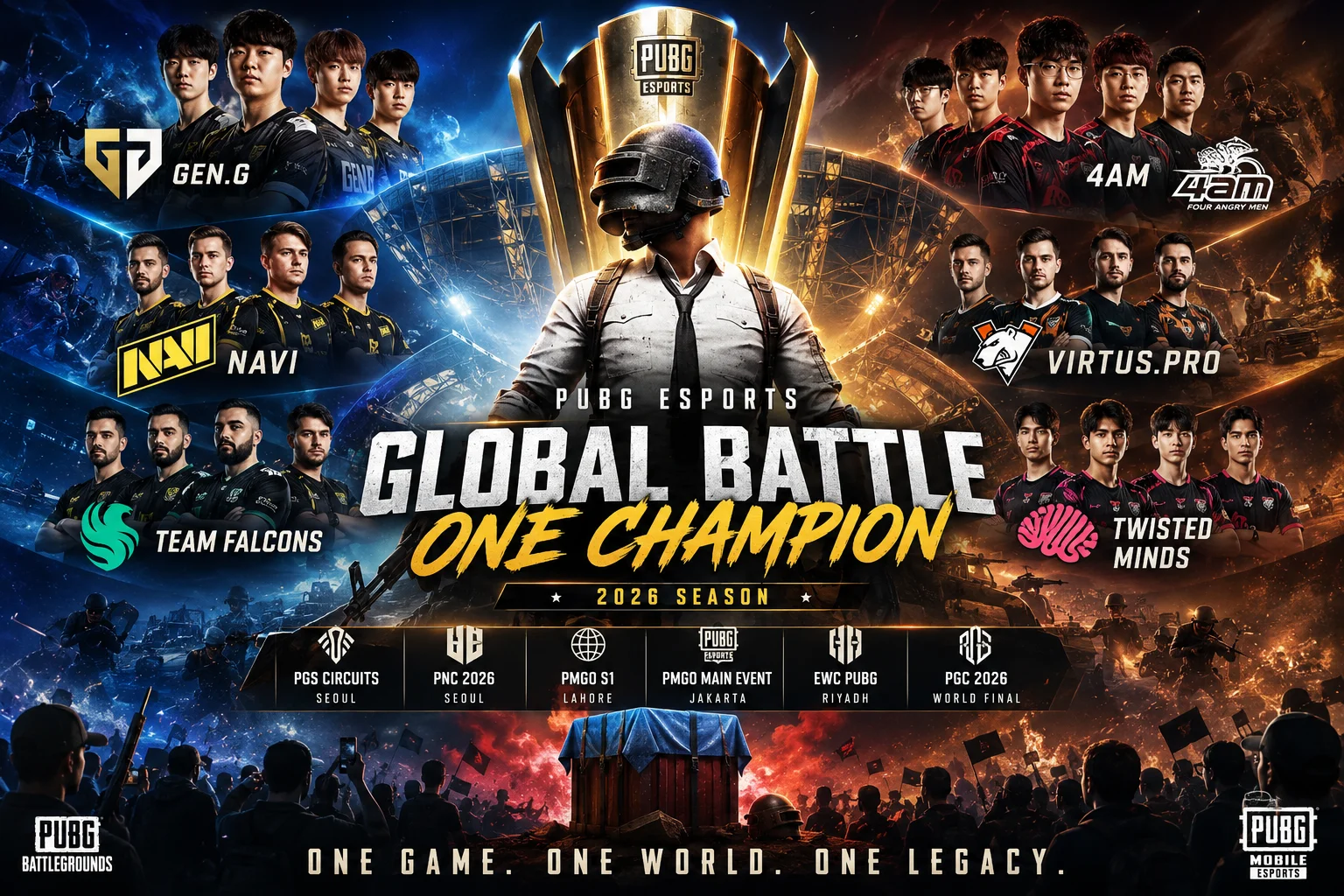
The 2026 PUBG Esports season introduces a brand-new Circuit format — three series linked together as one connected story, where results accumulate and carry forward across consecutive weeks. The first circuit ran from March 18 to April 5 in Seongsu, Seoul, South Korea, bringing together 24 teams from around the world. The total prize pool for the full 2026 PGS season is $2,000,000 across all four Circuits and twelve series. Gone are the days of standalone, disconnected events. Every match now has compounding consequences for PGS Points standings, qualification races, and the road to the PUBG Global Championship.
One of the most significant changes accompanying this new season is the official shift from First-Person Perspective (FPP) to Third-Person Perspective (TPP) as the primary competitive format. It's a move that raised eyebrows across the PC esports community, but KRAFTON's Head of PUBG Esports, Suyong Park, responded plainly: professional players are defined by preparation, game sense, and execution — not by which camera angle they use. The TPP transition also bridges a long-standing gap between PUBG's massive casual player base and its competitive scene, since the overwhelming majority of global players already play in TPP.
KRAFTON confirmed 12 Global Partner Teams on February 11, 2026, granting organizations like Gen.G Esports, Natus Vincere, Team Falcons, Virtus.pro, Twisted Minds, 4AM, Anyone's Legend, DN SOOPers, eArena, FULL SENSE, 17 Gaming, and Petrichor Road guaranteed participation across all PGS events throughout the season. These teams form the narrative spine of the circuit, while regional challengers compete for the remaining PGS slots — keeping the pathway open for rising organizations to reach the global stage.
The PUBG Nations Cup 2026 returns to Seoul's Jangchung Arena from June 23 to June 28, marking the venue's first use for PNC since the inaugural edition in 2019. The tournament features 24 competing nations, with Kazakhstan and Ukraine making their PNC debuts and Finland returning to the competition for the first time since 2022. Vietnam enters as the defending champion. The Nations Cup has always been where national pride overrides everything else — team loyalties, organizational affiliations, salary hierarchies — none of it matters when you're playing for your flag. With a Neutral Flag team also competing (widely expected to include Russian players, including four-time PGS champion Aleksandr "BatulinS" Batulin), PNC 2026 carries diplomatic significance that extends well beyond the game itself.
The PGS Circuit 4 Series Final is scheduled from October 29 to November 1, 2026, featuring 24 teams competing for a $300,000 prize pool. Before that, the Esports Nations Cup 2026 for PUBG: Battlegrounds runs November 11–15 in Riyadh, Saudi Arabia, organized by the Esports World Cup Foundation, with a prize pool of $1,120,000 and 24 competing nations. Capping the entire year, the PUBG Global Championship 2026 will feature 32 teams who have proven themselves throughout the season, with qualification determined across the full PGS 1–12 season and regional series — making it the most merit-based and geographically diverse PGC field in the game's competitive history.
PUBG Mobile Global Open 2026 Season 1 — South Asia Finals
When PUBG Mobile's South Asia Finals touched down at Lahore's Expo Center from May 14–17, 2026, it was more than a tournament. It was a statement. Pakistan — a country with a rapidly growing esports infrastructure and a passionate mobile gaming community — hosted an international KRAFTON-sanctioned event of this caliber for the first time, and the scene delivered on every front.
The PMGO 2026 Season 1 South Asia Finals was held at Hall No. 4, Expo Center Lahore, featuring 16 teams competing over 20 matches across four days with a $40,000 USD prize pool. Two teams received direct invitations based on performance: 4thrives Esports from Pakistan and Horaa Esports representing the broader South Asia circuit. The remaining spots were filled by four teams from the PMNC Bangladesh Spring, seven from the PMNC Pakistan Spring, and three from the PMNC South Asia Spring. The top three teams from the tournament qualified for the PMGO Season 1 Main Event.
The tournament was organized by KRAFTON, Level Infinite, and Esports Country, with all games conducted in Squads TPP mode on the official Infinix GT 50 Pro device. The first-place team earned $9,000 USD, second place secured $5,500 USD, and third place took home $4,500 USD.
The event wasn't without drama. Due to heavy rainfall and storm conditions in Lahore, Matches 4 and 5 were postponed after Match 3 on Day 1, forcing the schedule to be redistributed across the remaining days: Day 1 featured 3 matches, followed by 6, 6, and 5 matches across the final three days. The broadcast team responded with a now-memorable message — "The show pauses, but the battle continues tomorrow" — and the community embraced it.
By the end of Day 2, Pakistan's 4thrives Esports had secured first place in the overall standings with 103 points, one Chicken Dinner, and 69 eliminations across nine games. The team showcased consistent performances across both opening days of competition. By Day 3, Horaa Esports from Nepal had climbed to first place with 181 points, with 4thrives Esports holding second at 167 points after 15 matches.
In the final standings, 4thrives Esports claimed first place, earning $9,000 and 60 PMGC Points, while Horaa Esports finished second with $5,500 and 40 PMGC Points. Both teams, along with a third qualifier, earned spots in the PMGO Season 1 Main Event.
The PMGO 2026 Season 1 Main Event is an S-Tier tournament held in Jakarta, Indonesia from June 2 to 7, featuring 32 teams competing for a total prize pool of $500,000 USD. For 4thrives Esports, reaching Jakarta as South Asia's top seed is a milestone moment — not just for the organization, but for Pakistan's entire mobile esports identity.
It was also announced during the 2025 PMGC Grand Finals that the PMGO will be held twice in 2026, with Season 2 confirmed to take place in Pakistan — each edition featuring a total prize pool of $500,000 USD. That makes Pakistan a two-time international PUBG Mobile host within a single calendar year, reflecting the depth of KRAFTON's belief in South Asia as a growing esports market.
PUBG In-Game Events, Collaborations, and Seasonal Content
If PUBG's competitive calendar is the spine of 2026, the in-game content is the nervous system — keeping hundreds of millions of casual and semi-competitive players engaged between tournament cycles. The first half of 2026 has already been one of the most content-rich periods in the game's history.
Version 4.3, running from March 12 to May 10, marked PUBG Mobile's eighth anniversary with the "For Every #1" brand campaign. The update introduced an Evolving Universe themed mode transforming the battlegrounds across Erangel, Livik, and Miramar, featuring spacetime distortions, dynamic rail mechanics, and new racing gameplay. Collaborations included MrBeast launching on March 12, and the return of Jujutsu Kaisen from March 13 to April 12, featuring fan-favourite characters Yuji Itadori, Satoru Gojo, Ryomen Sukuna, and Suguru Geto.
Version 4.4 brought a major rework to Erangel's most iconic landmarks — Yasnaya Polyana, Ruins, Ferry Pier, and Mylta transformed into mythical ruins with temples, columns, and statues as part of the Hero's Crown and Divine Trials theme. A new floating island called Nimbus Island emerged as a premium hot drop zone featuring top-tier loot, additional revivals, and new active abilities including the Heart of Fury boost and the Spartan Flag buff expansion.
The May–July 2026 content window includes collaborations with Ford, the anime Blue Lock, and the K-pop group AESPA, alongside the new Royale Pass A19 and the launch of the S30 Ranked Season. The Harley-Davidson collaboration went live on May 15, allowing players to unlock orange-style motorcycle skins, biker gear, themed animations, and vehicle cosmetics. Royale Pass A19 and Ranked Season 30 launched on May 16, featuring beach and mythological cosmetics, mythic skins, and upgrade bonuses. The Blue Lock collaboration began on May 22, bringing jersey skins, soccer-style weapons, emojis, and mission-based progression through a Prize Path format.
No conversation about PUBG Mobile collaborations is complete without mentioning Alan Walker. The Norwegian DJ's original partnership with PUBG Mobile is widely regarded as one of the most iconic events in the game's history — beginning with "On My Way" during the one-year anniversary in 2019, a moment so beloved that players still argue no collaboration has matched its cultural impact. Walker returned for the 7th Anniversary in 2025 bringing back "On My Way" and "Faded," alongside a new track titled "Dust" — available during the Alan Walker x World of Wonder event on March 14. That collaboration reinforced what many longtime players already know: some partnerships are truly timeless.
Best Guns in PUBG
| Gun | Type | Damage | Best Use | Advantages | Weaknesses |
|---|---|---|---|---|---|
| M416 | Assault Rifle | 41 | Mid-range all-rounder | Low recoil, highly attachable, consistent at all stages | Needs full attachment setup to peak |
| AKM | Assault Rifle | 49 | Close to mid-range aggression | Highest damage AR, wrecks early-game with minimal loot | Heavy recoil; punishing at range |
| AWM | Sniper Rifle | 120 | Long-range one-shot dominance | Only gun that one-shots Level 3 helmets; air-drop exclusive | Crate-only, bolt-action slow, scarce ammo |
| UMP45 | SMG | 41 | Close-quarters, vehicle rushes | Excellent hipfire, outstanding DPS up close, widely available | Falls off quickly past 50 meters |
| Groza | Assault Rifle | 49 | Close-to-mid aggression (crate) | Fastest AR fire rate in the game; devastates in close combat | Air-drop only; limited attachment slots |
| SCAR-L | Assault Rifle | 43 | Mid-range stability | Easy recoil management, reliable for newer players | Lower ceiling than M416 with full attachments |
| DP-28 | LMG | 51 | Suppressive fire, mid-range | 47-round magazine, smooth recoil, low-loot friendly | Slow reload; prone stance needed for best accuracy |
| AUG A3 | Assault Rifle | 43 | Long-range precision (crate) | Extremely low recoil; becomes a laser with attachments | Air-drop only; limited availability |
| MK14 | DMR | 61 | Mid-to-long range semi-auto precision | Full-auto mode available; highest DMR damage in-game | Crate-only; brutal recoil in full-auto |
| Vector | SMG | 31 | CQC room clearing | Highest fire rate in the game; shreds in buildings and vehicles | Tiny base magazine; needs extended mag to shine |
For beginners, the SCAR-L and M416 are the natural starting points. Both have predictable recoil patterns that reward consistent crosshair placement, and neither requires a full attachment kit to be effective. The DP-28 is also a beginner-friendly powerhouse — its large 47-round magazine forgives slow reactions and rewards patient positioning.
In professional PGS play, the M416 and AKM remain the dominant AR combination for mid-game engagements, while DMRs like the MK14 and SLR create early positioning advantages that define map control. The AWM is non-negotiable in professional hands whenever it's available — the only weapon in the game capable of eliminating a player through maximum-tier armor with a single well-placed shot.
For close-range dominance, the Vector is the absolute king of room-clearing once equipped with an extended magazine, followed closely by the UMP45 for its flexibility and common ammo availability. The Groza, when you can find it in a crate, takes the top spot unconditionally. For long-range sniping without crate dependency, the Kar98K remains one of the most skill-expressive rifles in the game — a beautifully punishing weapon that has defined countless highlight moments across eight years of PUBG competition.
PUBG Esports Growth in 2026
The restructured PUBG Global Series circuit has given teams and fans a consistent weekly rhythm that wasn't present in previous seasons. Rather than waiting months between events, supporters now follow PGS Circuits like a league season — weekly results, cumulative point standings, and clear narratives building toward PGC. This structural shift has measurably improved viewer engagement across KRAFTON's broadcast channels and streaming platforms globally.
South Asia is the fastest-growing region in PUBG Mobile esports right now, and the numbers are starting to back up what the competitive performances already showed. Pakistan, Nepal, Bangladesh, and India are producing tournament-ready squads at a pace that few other regions can match. The PMGO S1 South Asia Finals held offline in Lahore drew massive viewership across the PUBG Mobile Esports South Asia channels — and 4thrives Esports winning the event in front of a home crowd was the kind of milestone moment that builds lasting community investment in the sport.
The 12 Global Partner Team model has attracted mainstream esports organizations into PUBG's orbit in a more structured way than any previous season. KRAFTON's vision of "competitiveness and merit" blends the roadmap with grassroots qualifiers alongside elite partner team representation — with open regional qualifiers allowing challengers to compete for PGS and PGC spots at any point in the season. Teams like Gen.G, Natus Vincere, and Team Falcons bring both organizational professionalism and large social followings, translating PUBG matches into broader cultural moments that reach beyond the core esports audience.
The in-game sponsorship landscape tells a similar story. Ford, Harley-Davidson, Infinix (official device for PMGO South Asia), Blue Lock, and AESPA demonstrate that global brands increasingly view PUBG Mobile as a credible marketing platform — one that reaches young, digitally-native audiences at scale across South Asia, Southeast Asia, the Middle East, and beyond.
The Future of PUBG Global Esports
Where does PUBG go from here? The 2026 season has answered that question more clearly than any year prior — not by chasing the flashy moves of Fortnite or the casual accessibility of Free Fire, but by doubling down on structural integrity, regional depth, and the kind of sustained competitive excitement that keeps serious esports communities engaged for years.
KRAFTON's ongoing work with KeSPA toward potential PUBG inclusion in the Olympic Esports Games is one of the more consequential storylines in the game's competitive future. KRAFTON's decision to permit the use of a Neutral Flag at PNC 2026 ties into its broader push to have PUBG included in the Olympic Esports Games, with the company having established a working relationship with the Korea e-Sports Association toward that goal. If PUBG enters the Olympic Esports ecosystem, the legitimacy and resource implications for the entire scene would be significant.
The TPP competitive transition is a strategic long play that prioritizes ecosystem health over short-term community comfort. By making the format millions of casual players already use the competitive standard, KRAFTON removes one of the friction points that previously stopped everyday players from feeling connected to professional matches. The gap between "playing PUBG" and "watching PUBG" becomes smaller — and that's exactly where sustainable esports audiences are built.
On the technology front, KRAFTON continues investing in AI-assisted anti-cheat detection and real-time behavioral analysis. The competitive integrity of events like PGS and PMGO depends on this infrastructure working effectively, and it remains a foundational investment in the 2026 roadmap alongside content and gameplay development.
PMGC 2026 has already been confirmed to return to Türkiye with a total prize pool of $3,000,000 USD — matching the record-setting 2025 edition and cementing mobile esports' financial maturity. Combined with PMGO Season 2 landing in Pakistan and the Esports Nations Cup arriving in Riyadh, the second half of 2026 represents the most geographically diverse stretch of premium PUBG tournaments ever assembled.
Looking toward 2027 and beyond, PUBG's competitive ceiling remains genuinely high. More regions earning dedicated event slots. Bigger prize pools. Deeper community pipelines running from grassroots scrimmages all the way to world championships. The game that started with one guy jumping out of a plane onto an abandoned island has built something that outlasted most of its early competitors — and in 2026, it's showing no signs of slowing down.
FAQ
When did Alan Walker partner with PUBG Mobile?
Alan Walker's first collaboration with PUBG Mobile launched on March 20, 2019, with the iconic track "On My Way," performed alongside Sabrina Carpenter and Farruko. This partnership, introduced during the game's one-year anniversary, is widely regarded as one of the most iconic events in PUBG Mobile history — with players arguing to this day that no collaboration has surpassed it. Walker subsequently returned with "Live Fast" in July 2019, "Paradise" in September 2021, "Land of Heroes" during the 2023 World Invitational, and most recently for the 7th Anniversary on March 7, 2025 with "On My Way," "Faded," and a new track titled "Dust."
How to create custom skins in PUBG?
In PUBG: Battlegrounds (PC and console), custom cosmetics are primarily created through the in-game crafting system, where players combine materials earned from gameplay or store purchases to craft specific weapon finishes and character items. PUBG Mobile takes this further with World of Wonder — a creator mode that allows community-built content and event integration, backed by a $10 million creator reward program introduced in 2026. Limited-edition craftable cosmetics also appear regularly through collaboration events and seasonal reward tracks.
Is PUBG cross platform?
PUBG: Battlegrounds on PC and console does not support cross-platform play between PC and console players — they operate in separate matchmaking pools. Xbox and PlayStation players, however, can play together in cross-console lobbies. PUBG Mobile is an entirely separate game with its own ecosystem and does not share progression or matchmaking with the PC version. Emulator players on PC are matched against each other rather than against touchscreen mobile users. As of May 2026, KRAFTON has not announced full cross-platform integration between PC and console for PUBG: Battlegrounds.
Can you change your PUBG username?
Yes, in both PUBG: Battlegrounds and PUBG Mobile. In Battlegrounds on PC, your display name is tied to your Steam profile — changing it there updates it in-game automatically. In PUBG Mobile, tap the pencil icon next to your name on your profile page to edit it. The first name change in PUBG Mobile is free; subsequent changes require a Name Change Card, which can be purchased from the store or earned through seasonal events and milestone rewards.
What does PUBG stand for?
PUBG stands for PlayerUnknown's Battlegrounds. "PlayerUnknown" is the online alias of Brendan Greene, the Irish game designer who developed the original battle royale mod for Arma 2 that inspired the genre. Greene partnered with South Korean publisher KRAFTON (then known as Bluehole) to build the standalone game, which launched into PC Early Access in March 2017. The full official title was updated to "PUBG: Battlegrounds" in January 2022 when the game transitioned to a free-to-play model.
Conclusion
Eight years in, PUBG is playing a longer game than almost anyone in the battle royale space — and it's winning on points. The 2026 season brings together a restructured competitive ecosystem, landmark events in Seoul and Lahore, a world-class mobile circuit with genuine global stakes, and a content calendar that keeps hundreds of millions of players engaged between tournaments.
The PMGO South Asia Finals in Lahore proved that great esports stories don't only happen in Seoul, Jakarta, or São Paulo. They happen wherever passion for the game runs deep enough — and in Pakistan, in Nepal, in Bangladesh, that passion is now translating into world-class competitive talent and international recognition. 4thrives Esports carrying South Asia's banner to Jakarta is exactly the kind of story that reminds you why regional esports development matters.
From the Jangchung Arena's PNC Grand Finals in June, through the Esports World Cup's PUBG bracket, to PGC 2026's 32-team world championship finale in December — the road ahead is stacked, consequential, and genuinely exciting. PUBG isn't just the game that started the battle royale genre. In 2026, it might be the one that gets the last word on how to build one that actually lasts.
Be the first to comment!