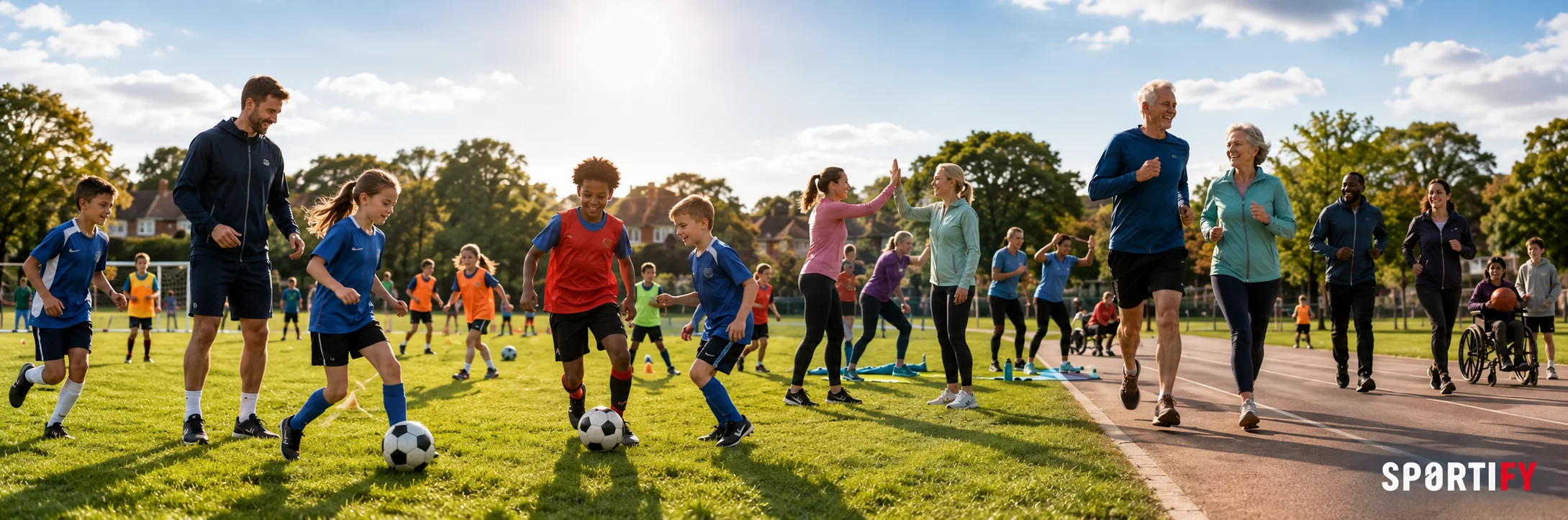
Have you ever wondered how a small town builds a thriving local football league or gets better PE equipment into its schools? A County Sports Partnership often sits quietly behind that progress. These local networks connect schools, clubs, councils, and health bodies to boost grassroots sport across a whole county. Their entire mission centers on one simple goal: getting more people moving, more often. From tackling the fitness postcode lottery to supporting school sport and reducing inactive adults, CSPs shape community wellbeing in ways most people never notice. This guide breaks down what these partnerships actually do, how they're funded, and why they matter so much today.
What Are County Sports Partnerships (CSPs)?
A County Sports Partnership (CSP) is a local network built to grow sport participation in a specific area. Think of it as a bridge. It connects schools, clubs, local authorities, and health bodies. Its whole job is to make sport and movement easier to access for everyone, no matter their age or ability.
There are more than forty of these networks across England. Each one covers a county or a group of local authorities. Together, they form what people in the sector call the CSP Network (CSPn). This shared identity helps them speak with one voice when working with national partners like Sport England.
Definition and Core Purpose
At its core, a CSP exists to answer one simple question: how do we get more people active? That is the role of a county sport partnership in a nutshell. It is not about running elite competitions. It is about grassroots sport. It is about the everyday runner, the after-school football club, and the retiree taking up walking again.
CSPs focus on three big goals. They want more adults moving regularly. They want fewer inactive adults sitting on the sidelines. And they want young people building healthy habits early. This mission touches community sport, school sport, and public health all at once. It is a broad job, and that is exactly why partnership working matters so much here.
Brief History and Origins
CSPs did not appear overnight. They were created around the turn of the millennium as part of a bigger push to modernize sports development in England. Government and sport leaders realized something important. National plans only work if someone delivers them locally. That is where CSPs stepped in.
Early on, most CSPs operated as a hosted organisation. This meant they sat inside a county council, a university, or another public body. Over time, many shifted toward independence. Some became a company limited by guarantee (CLG), gaining full incorporated status and charity recognition. This shift gave them more freedom over budgets and strategy, though it also brought new responsibilities.
County Sports Partnerships vs. Active Partnerships (naming evolution)
Here is something that confuses a lot of people. County Sports Partnerships and Active Partnerships are, in most respects, the same network. The name changed over time as the sector rebranded to better reflect its widening focus beyond traditional sport toward broader physical activity and wellbeing.
So when someone asks about the difference between CSP and Active Partnerships, the honest answer is simple. It is mostly a naming evolution, not a structural overhaul. Some local organizations kept older branding. Others adopted the newer Active Partnerships identity fully. Either way, the mission stayed consistent: local, place-based support for movement and sport.
| Term | Era Commonly Used | Focus |
|---|---|---|
| County Sports Partnership (CSP) | Early 2000s onward | Sport participation, local coordination |
| Active Partnerships | More recent rebrand | Physical activity, wellbeing, inclusion |
Who Runs County Sports Partnerships?
CSPs do not operate alone. They sit inside a wider web of national bodies, local government, and voluntary groups. Understanding who runs them helps explain why their funding and priorities sometimes shift from year to year.
Two organizations shape this landscape the most. One provides funding and strategic direction. The other represents the wider voice of the sport and recreation sector. Together with local authorities, they form the backbone of how CSPs get their marching orders and their money.
Relationship with Sport England
Sport England is the single biggest influence on how CSPs operate. As the main funder, Sport England sets national priorities through documents like the Sport and Physical Activity Strategy. CSPs then translate those national goals into local delivery that fits their specific communities.
This relationship is not a one-way street, though. Sport England relies on CSPs for grassroots insight. Local teams know their communities better than any national office ever could. That local knowledge shapes how future strategies get written, creating a feedback loop between national policy and place-based solutions on the ground.
Relationship with the Sport and Recreation Alliance
The Sport and Recreation Alliance plays a different role. It is a membership body representing over 320 organizations, from major sports like football and cricket to smaller niche groups. Its job leans toward advocacy. It lobbies government, supports governance standards, and champions the sector's interests in Parliament.
While the Alliance does not fund CSPs directly, it shapes the policy environment they operate within. When the Alliance pushes for better business rates for sports clubs or stronger EDI standards, those wins trickle down and affect the conditions CSPs work in every day.
Governance and Funding Structure
Governance varies a lot between CSPs, and that is by design. Some remain a semi-autonomous organisation nested inside a local authority or county council. Others run fully independently as registered charities. Each funding cycle brings fresh questions about which model works best for accountability and flexibility.
Most CSPs blend several income sources. Core funding often comes from Sport England, but many partnerships also draw on Local Enterprise Partnerships (LEPs), local council grants, and commercial income. This mixed model demands strong governance and open data practices, since multiple funders expect transparency and measurable results.
What Do County Sports Partnerships Actually Do?
So what does a CSP actually do day to day? This is where the mission turns into action. CSPs run programs, broker relationships, and quietly coordinate a huge amount of local sport activity that most people never see credited to them.
Their work spans four major areas. Each one connects back to the central goal of raising physical activity levels while reducing inequality in who gets to enjoy sport. Let's walk through them one by one.
Grassroots Sport and Physical Activity Programs
This is the heart of the job. CSPs design and support programs that get everyday people moving. That might mean a walking football league for older adults. It might mean funding a community boxing gym in an underserved neighborhood. The common thread is always grassroots sport built around real local need.
These programs rarely make headlines, but their reach is enormous. A single CSP might support dozens of clubs, hundreds of volunteers, and thousands of participants across a county in a single year. That quiet, steady work is exactly why community sport keeps functioning at the local level.
Supporting Schools and PE Delivery
CSPs also play a direct role in school sport. They help schools use funding like the Primary PE and Sport Premium effectively, ensuring money translates into better facilities, coaching, and opportunities for kids to move during the school day.
Many CSPs also support the School Games, a national competition structure that gives young athletes a pathway from school-level events to regional and national stages. This work matters because early habits stick. A child who enjoys PE and school sport is far more likely to stay active as an adult.
Tackling Health Inequality and the "Fitness Postcode Lottery"
Not every neighborhood has equal access to sport facilities, parks, or safe places to be active. This gap has a name in the sector: the fitness postcode lottery. CSPs work hard to close that gap, targeting funding and programs toward areas facing the steepest health inequality.
This is where sport crosses into public health territory. Physical inactivity links directly to obesity, dementia, diabetes, and other long-term conditions. By focusing resources on underserved areas, CSPs contribute to chronic disease prevention and support the wider physical activity and health agenda shared across government departments.
Working with National Governing Bodies (NGBs) and NDSOs
CSPs also serve as local connectors for National Governing Bodies (NGBs), the organizations that run individual sports like football, netball, or athletics. NGBs set national rules and standards, but they need local partners to actually deliver programs on the ground. That is where CSPs step in.
The same applies to disability sport. CSPs frequently coordinate with a National Disability Sports Organisation (NDSO) to make sure inclusive programs reach people with disabilities at the local level. This collaboration ensures sport for development efforts do not leave anyone behind.
How CSPs Fit Into the Wider Sports Ecosystem
England's sport system can feel like a maze of acronyms. Understanding where CSPs sit inside that bigger picture makes everything click into place. They are not the top of the pyramid, and they are not the bottom either. They sit right in the middle, connecting national strategy to local action.
This middle position is exactly what makes CSPs so valuable, and sometimes so misunderstood. They translate abstract policy goals into programs real people can join. Let's look at how that translation actually works.
CSPs and NGBs: Roles and Collaboration
NGBs focus on their specific sport nationally. A national netball body, for example, sets coaching standards and competition rules across the whole country. CSPs, on the other hand, focus on a place rather than a sport. Their job is to make sure many different NGBs can find local partners, venues, and volunteers.
This division of labor works well most of the time. NGBs bring expertise in their sport. CSPs bring local knowledge and relationships. When these two sides collaborate closely, participation numbers tend to rise. When communication breaks down, programs can stall, which is one reason relationship management is such a valued skill in this sector.
UK Sport vs. Sport England: Key Differences and Overlaps
People often mix up UK Sport and Sport England, but they serve very different purposes. UK Sport invests in elite athletes chasing Olympic and Paralympic medals. Sport England focuses on everyday participation, from school kids to retirees. One chases podiums. The other chases healthier communities.
| Organization | Main Focus | Typical Audience |
|---|---|---|
| UK Sport | Elite performance, medals | Olympic and Paralympic athletes |
| Sport England | Grassroots participation, wellbeing | General public, community groups |
Despite these differences, both organizations share one overlapping goal: a healthier, more active nation. CSPs align almost entirely with Sport England's mission, since their work centers on sport participation at the community level rather than elite performance.
Where CSPs Sit in Local vs. National Sport Delivery
Picture a funnel. National strategy sits at the top, broad and ambitious. Local delivery sits at the bottom, specific and practical. CSPs live in the middle of that funnel. They take national ambition and shape it into something that actually fits a specific town or county.
This middle position requires constant balancing. National funders want consistency and measurable outcomes across the country. Local communities want flexibility that reflects their unique needs. Navigating between central control vs. local flexibility is one of the trickiest parts of running a successful CSP.
The Impact of County Sports Partnerships
Numbers tell a powerful story here. CSPs are not just administrative bodies pushing paperwork. Their programs shape real health outcomes, community connections, and opportunities for people who might otherwise never find their way into sport.
Measuring that impact takes more than gut feeling, though. The sector leans on solid data and real community stories to prove its worth to funders and policymakers alike.
Physical Activity and Public Health Outcomes
Regular movement lowers the risk of heart disease, supports mental health, and improves quality of life at every age. CSPs contribute to these outcomes by making activity more accessible, especially for groups who face the biggest barriers to getting started.
This work connects closely with Public Health England priorities and local Clinical Commissioning Groups (CCGs), which manage health services and increasingly recognize movement as a form of preventative medicine. When sport and healthcare teams collaborate well, everyone benefits, from the patient to the taxpayer footing the healthcare bill.
Data from the Active Lives Adults Survey
Sport England tracks national activity trends through the Active Lives Adults Survey, a large-scale study that measures how often adults across the country move their bodies. This data helps CSPs identify exactly which communities need the most support.
The survey consistently shows gaps between wealthier and lower-income areas, reinforcing why the fitness postcode lottery remains such an important focus. Tracking this data over time also helps CSPs prove whether their local programs are actually shifting the needle on participation.
Community and Regional Case Studies
Take the East Midlands as one example region where CSP activity has been closely studied by researchers. Academic reviews of partnerships in this area highlighted both strong local relationships and real operational challenges, offering useful lessons for the rest of the network.
These regional stories matter because they ground abstract policy in real life. A single successful walking group in one town, or a school PE program that doubled participation in a year, often becomes the evidence funders point to when deciding where future investment should go.
Challenges Facing County Sports Partnerships
No system this complex runs perfectly. CSPs face real, persistent challenges that shape how effectively they can deliver on their mission. Being honest about these struggles actually helps explain why the sector keeps evolving.
Funding pressure sits at the top of almost every conversation about CSPs. But money is not the only obstacle standing in their way.
Fragility and Funding Uncertainty
Many CSPs operate on funding cycles that renew every few years, creating constant uncertainty about long-term planning. This fragility of partnership working makes it hard to commit to multi-year programs, since staff and budgets can shrink or disappear when a funding cycle ends without renewal.
Academic research into the sector has specifically flagged this instability as one of the defining challenges CSPs face. Building something sustainable becomes difficult when the ground keeps shifting beneath your feet every couple of years.
Complexity of Partnership Working
Coordinating a multi-agency partnership sounds simple on paper. In practice, it means juggling different priorities, timelines, and reporting requirements from schools, health bodies, local councils, and national sport organizations all at once.
Research has found real confusion among some partner agencies about what a CSP's role actually is. This misunderstanding can slow down collaboration and create friction, even when everyone technically wants the same outcome: more people active and healthier communities.
Measuring Long-Term Effectiveness
Proving impact is harder than it sounds. Short-term participation numbers are easy to track. Long-term health improvements, like reduced healthy life expectancy decline or lower chronic disease rates, take years to show up clearly in the data.
This creates pressure for evidence-based policy that funders can trust. CSPs increasingly need strong case study analysis and rigorous data collection to demonstrate that their work delivers real, lasting value rather than short bursts of activity that fade once funding ends.
The Future of County Sports Partnerships
Where does this sector go from here? CSPs are not standing still. They continue adapting to new government priorities, new health challenges, and a changing funding landscape that demands smarter, leaner ways of working.
Looking ahead, three trends stand out clearly across recent sector news and strategy documents.
Sector Recognition — Awards and Advocacy
The sector celebrates its wins publicly, and that visibility matters. Recognition programs like the Community Sport and Recreation Awards highlight standout local projects each year, giving smaller CSPs a platform to showcase innovative work that might otherwise go unnoticed nationally.
This kind of advocacy strengthens the sector's voice with government too. When success stories reach policymakers, it becomes easier to argue for continued or increased investment in local delivery models that clearly work.
Policy Shifts Affecting CSPs
Government reviews periodically reassess the role of a county sport partnership within the wider strategy. Past reviews, led through the Department for Culture, Media and Sport (DCMS) and Sport England, have asked tough questions about whether current structures still fit modern needs.
These reviews often weigh central control vs. local flexibility, asking whether a single national model works better than allowing each CSP room to adapt locally. The answer tends to land somewhere in the middle, favoring shared standards alongside local judgment.
Emerging Priorities (older adults, inactivity, funding reform)
Three priorities keep rising to the top of sector conversations. First, supporting older people's health through low-impact movement programs as the population ages. Second, tackling stubborn rates of inactive adults, particularly in disadvantaged communities. Third, pushing for more stable, diversified funding models that reduce dependence on short cycles.
These priorities suggest the next chapter for CSPs will lean even further into public health collaboration, moving beyond traditional sport clubs toward broader sport for development work that touches every stage of life.
FAQs
Got quick questions? Here are straightforward answers to some of the most common ones people search for.
What is the difference between a CSP and an Active Partnership?
Honestly, very little in most cases. The difference between CSP and Active Partnerships mostly comes down to branding and timing. Active Partnerships is the newer name many networks adopted as they broadened their focus from sport alone toward wider physical activity and wellbeing goals.
How are County Sports Partnerships funded?
How are CSPs funded is a common question, and the answer is: through multiple sources. Sport England provides the largest share, but local councils, Local Enterprise Partnerships (LEPs), health bodies, and commercial partnerships also contribute, creating a mixed funding model across the network.
How can organizations get involved with a local CSP?
Most CSPs welcome partnerships with schools, clubs, health services, and community groups. The best first step is reaching out directly through a local partnership's website or contacting the national network for a CSP network members list, which points organizations toward their nearest local contact.
What are county sports partnerships?
County Sports Partnerships (CSPs) are local networks that connect schools, clubs, councils, and health bodies to boost sport participation and physical activity across a specific county.
What are some examples of partnerships in sports?
Examples include a CSP working with a National Governing Body (NGB) to run local coaching programs, or a partnership between schools and health bodies to deliver the School Games.
What do local sports partnerships do?
They coordinate grassroots sport programs, support PE in schools, and target funding toward communities facing the biggest barriers to staying active.
What do sports partnerships do?
They act as a bridge between national sport strategy and local delivery, turning big-picture goals into real programs people can actually join.


Be the first to comment!