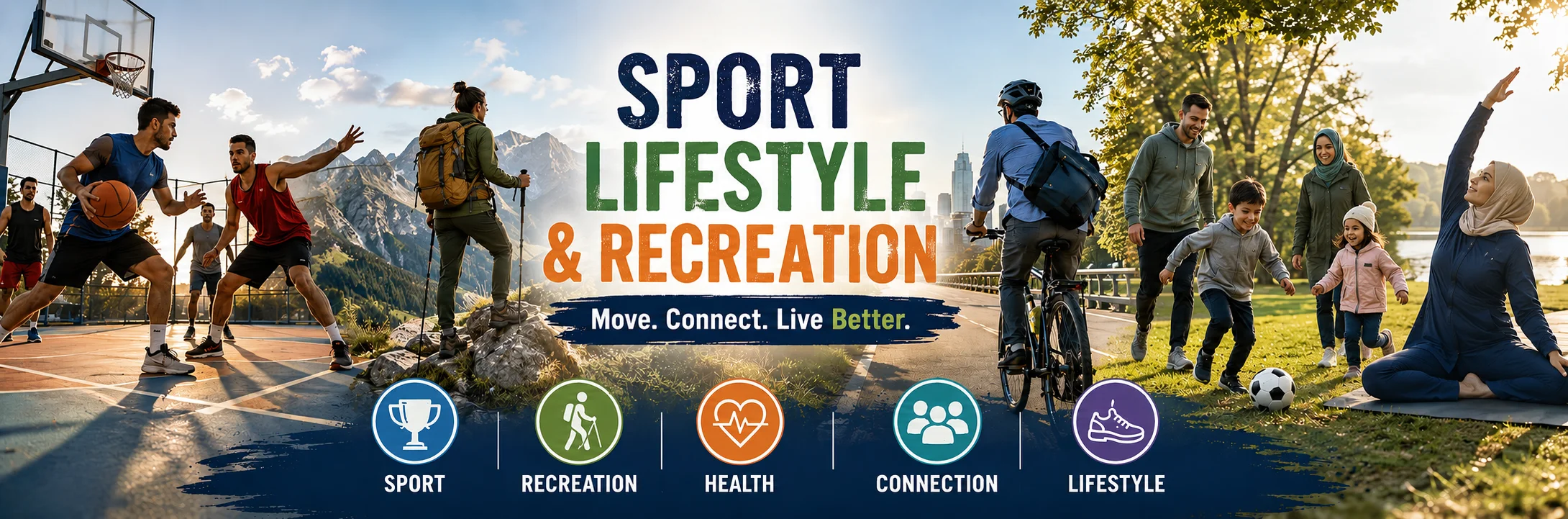
Three words, one idea sitting at the center of a healthy life: sport, lifestyle, and recreation. Most people use them interchangeably, and that's part of the problem — sport, lifestyle, and recreation are related but distinct pieces of how humans stay active, connected, and well. Physical inactivity is one of the leading risk factors for death worldwide, yet for most people the hard part isn't finding the motivation to move — it's never building movement into a system that actually fits their life.
This guide breaks down what sport, lifestyle, and recreation each mean, why all three matter together, the different forms they take, and a practical way to build them into your routine — whatever your age, schedule, or fitness level.
What Does "Sport, Lifestyle and Recreation" Actually Mean?
These three words get blended together constantly, but they describe three different things:
- Sport is structured, rule-bound physical activity with a defined format and a measurable outcome — a score, a time, a win or a loss. Football, competitive swimming, and tennis are all sports.
- Recreation is activity done mainly for enjoyment, relaxation, or personal satisfaction. It doesn't need formal rules or a competitive outcome to count. Hiking, casual cycling, fishing, and dancing for fun all fall under recreation.
- Lifestyle isn't an activity at all — it's the ongoing pattern of habits and choices that determines how much movement, of any kind, actually makes it into your week. A lifestyle can include sport, recreation, both, or neither.
Put together, "sport, lifestyle and recreation" describes the full spectrum of how people stay physically and socially active — from organized competition to unstructured play, held together by the daily habits that make any of it sustainable.
| Aspect | Sport | Recreation | Lifestyle |
|---|---|---|---|
| Structure | High — rules, formats, officials | Low to none | Not an activity — it's the pattern around all activities |
| Primary goal | Competition, skill, achievement | Enjoyment, relaxation, connection | Consistency over time |
| Typical example | Joining a basketball league | A weekend hike with friends | Walking to work, taking the stairs |
| Social setting | Usually team or organized | Solo or informal group | Embedded into daily routine |
Why Sport, Lifestyle and Recreation Matter
Physical health
Regular movement — sport or recreational — lowers the risk of cardiovascular disease, stroke, type 2 diabetes, and several cancers. Most national health bodies, including the World Health Organization, recommend adults get roughly 150–300 minutes of moderate activity (or 75–150 minutes of vigorous activity) each week. It doesn't have to come from a gym or a team; a brisk daily walk, a weekend football game, and an active commute can all add up to the same number.
Mental and emotional health
Physical activity triggers the release of endorphins and other neurochemicals linked to mood regulation, which is why movement is consistently associated with lower rates of anxiety and depressive symptoms. It also improves sleep quality and, particularly in older adults, supports cognitive function and helps slow age-related decline.
Social health
Team sports, recreational leagues, and group activities like walking clubs or dance classes build a sense of belonging that's hard to replicate elsewhere. In a period where social isolation is increasingly recognized as a public-health concern in its own right, shared physical activity is one of the most reliable ways to build and maintain real-world connection.
Community and economic benefits
The advantages extend past the individual. Communities with strong sport and recreation infrastructure — parks, leisure centers, clubs, and accessible programs — tend to see lower healthcare costs, stronger local economies (through retail, tourism, and facility employment), and tighter social cohesion. Investment in recreation is, in effect, investment in public health and local identity at the same time.
The Different Types of Sport, Lifestyle and Recreation
Types of sport
- Team sports — football, basketball, cricket, rugby
- Individual sports — tennis, swimming, athletics, golf
- Competitive leagues — structured, ranked, often with selection and training requirements
- Casual or social leagues — same sports, relaxed stakes, open to all skill levels
Types of recreation
- Active recreation — hiking, cycling, kayaking, climbing
- Passive recreation — picnics, birdwatching, fishing, sitting by the water
- Indoor recreation — board games, bowling, indoor climbing
- Outdoor recreation — camping, trail running, beach days
Lifestyle integration
This is the piece most guides skip, and it's arguably the most important:
- Active commuting — walking or cycling instead of driving
- Workplace movement — standing desks, walking meetings, stair use
- Incidental activity (NEAT) — the small, unplanned movement throughout a normal day, which research shows can account for a surprisingly large share of total daily energy expenditure
- Weekend and family habits — the recurring activities a household builds around, from Sunday hikes to backyard games
How to Build a Sport, Lifestyle and Recreation Routine
By life stage
- Children — benefit most from unstructured, play-based movement and exposure to a variety of school or community sports, which builds fundamental motor skills before specializing in any one activity.
- Teens — structured school or club sport plus informal recreation with friends helps cement habits that tend to carry into adulthood.
- Adults — the realistic goal is a mix: some structured activity for fitness, some recreation for enjoyment and stress relief, fitted around work and family rather than competing with them.
- Older adults — lower-impact recreation (walking groups, swimming, tai chi, gentle cycling) supports balance, fall prevention, and — just as importantly — ongoing social contact.
By time and commitment level
- Busy professionals — short, frequent sessions and active commuting beat waiting for a free hour that never arrives.
- Complete beginners — start with recreation, not competitive sport. The lower stakes make consistency easier, and skills/fitness can build from there.
- Parents — look for family-inclusive recreation and community programs rather than treating activity as something that has to happen separately from family time.
By interest or personality
- Competitive types → a structured league gives you the accountability and stakes you're looking for.
- Social types → group classes or team recreation deliver activity and connection in one package.
- Solitary or introverted types → individual sport or solo recreation — running, swimming, hiking — offers activity without the social pressure.
- Outdoor-oriented types → hiking, kayaking, cycling, and climbing turn movement into exploration.
Common Barriers — and How to Overcome Them
- Cost — many local councils and community centers run free or low-cost recreation programs, and public parks and trails cost nothing to use.
- Time — short sessions, active commuting, and stacking activity onto existing routines (walking while on a call, cycling to errands) close most of the gap.
- Access — home-based recreation, neighborhood walking groups, and free outdoor spaces remove the need for paid facilities altogether.
- Motivation — joining a club or recreation group builds in the accountability that solo plans usually lack.
- Fear of injury or failure — starting with lower-stakes recreation rather than competitive sport, warming up properly, and getting guidance when trying something new all reduce the risk that stops people before they start.
The Role of Clubs, Communities, and Organizations
Joining a structured group is consistently one of the biggest predictors of whether an activity habit sticks. Local sports clubs, recreation centers, running groups, and community leagues remove the daily "what should I do today" decision, replace it with a fixed time and place, and add the social reinforcement that keeps people showing up even when motivation dips on its own.
Sport, Lifestyle and Recreation Trends Today
- Informal, social fitness is booming — run clubs, pickup games, and the rapid rise of social racket sports like padel and pickleball reflect a shift away from solitary gym culture toward shared, low-pressure activity.
- Wearables and apps have made everyday lifestyle activity trackable and, increasingly, gamified — turning incidental movement into something people actively monitor and compete with themselves over.
- The center of gravity is shifting from gyms to lifestyle — fewer people frame fitness as something that only happens in a dedicated session, and more treat it as something woven through an ordinary day.
- "Third spaces" are emerging — activities that combine recreation, fitness, and socializing in one event, like run clubs that finish at a café or adult social sport leagues built around the post-game hangout as much as the game itself.
FAQs
What is a lifestyle sport?
A lifestyle sport is a casual, low-stakes sport people take up as part of everyday recreation and personal identity rather than for competition — surfing, skateboarding, casual cycling, and climbing are common examples. The focus is enjoyment and a way of life, not winning.
How do lifestyle activities differ from sports activities?
Lifestyle activities are the everyday, often unplanned movement built into daily routine — walking, cycling to work, gardening — while sports activities are structured and rule-based, with a defined format and outcome. The two overlap, but you can have an active lifestyle without playing any formal sport, and you can play a sport without otherwise living an active daily life.
What is a recreational sport?
A recreational sport is a sport played mainly for fun, fitness, and social connection rather than at a competitive or elite level — think informal leagues and pickup games. It uses the same rules and skills as competitive sport, just without the stakes.
What does "recreational" mean in sports?
"Recreational" describes a level of participation focused on enjoyment and casual involvement rather than competition, ranking, or professional development. It's the term used to separate casual participants from competitive or elite athletes.
What is the difference between sports and recreation?
Sport refers to the structured activity itself, with defined rules and formats. Recreation is broader — it covers any enjoyable leisure activity, whether sport-based or not, such as fishing, gardening, or reading. Sport can be a form of recreation, but recreation isn't limited to sport.
What is the difference between recreational and competitive sports?
Recreational sport prioritizes participation, fun, and fitness for players of any skill level, usually with relaxed rules and lower stakes. Competitive sport involves structured leagues, rankings, selection processes, and a primary focus on performance and winning.
What is recreational sports in high school?
In a high school setting, recreational sports usually mean non-varsity, intramural, or club-level activities offered for participation and fitness rather than competitive representation of the school — open to students regardless of skill level.
What is sports and recreation management?
Sports and recreation management is the field focused on planning, organizing, and overseeing sports facilities, programs, and events — covering roles in community recreation centers, sports clubs, local government parks departments, and event management.
How do I start a recreational sports league?
Pick a sport and format, recruit players or teams through community boards, local groups, or social media, secure a venue, set a simple rule set and schedule, decide on costs and equipment, and use a basic sign-up system — an app or even a shared spreadsheet — to manage registration and standings.
Key Takeaways
- Sport, lifestyle, and recreation are related but different: sport is structured and rule-based, recreation is enjoyment-first and unstructured, and lifestyle is the daily pattern that ties everything together.
- The benefits span physical health, mental wellbeing, social connection, and even community-level economic impact.
- The most sustainable routines mix structured sport, casual recreation, and everyday lifestyle activity — matched to your stage of life, schedule, and personality.
- Joining a club, league, or group is one of the most reliable ways to make any of this stick.
Building a genuine sport, lifestyle and recreation habit isn't about a perfect plan — it's about finding the mix of structure and play that fits how you actually live, then showing up for it consistently.
Be the first to comment!