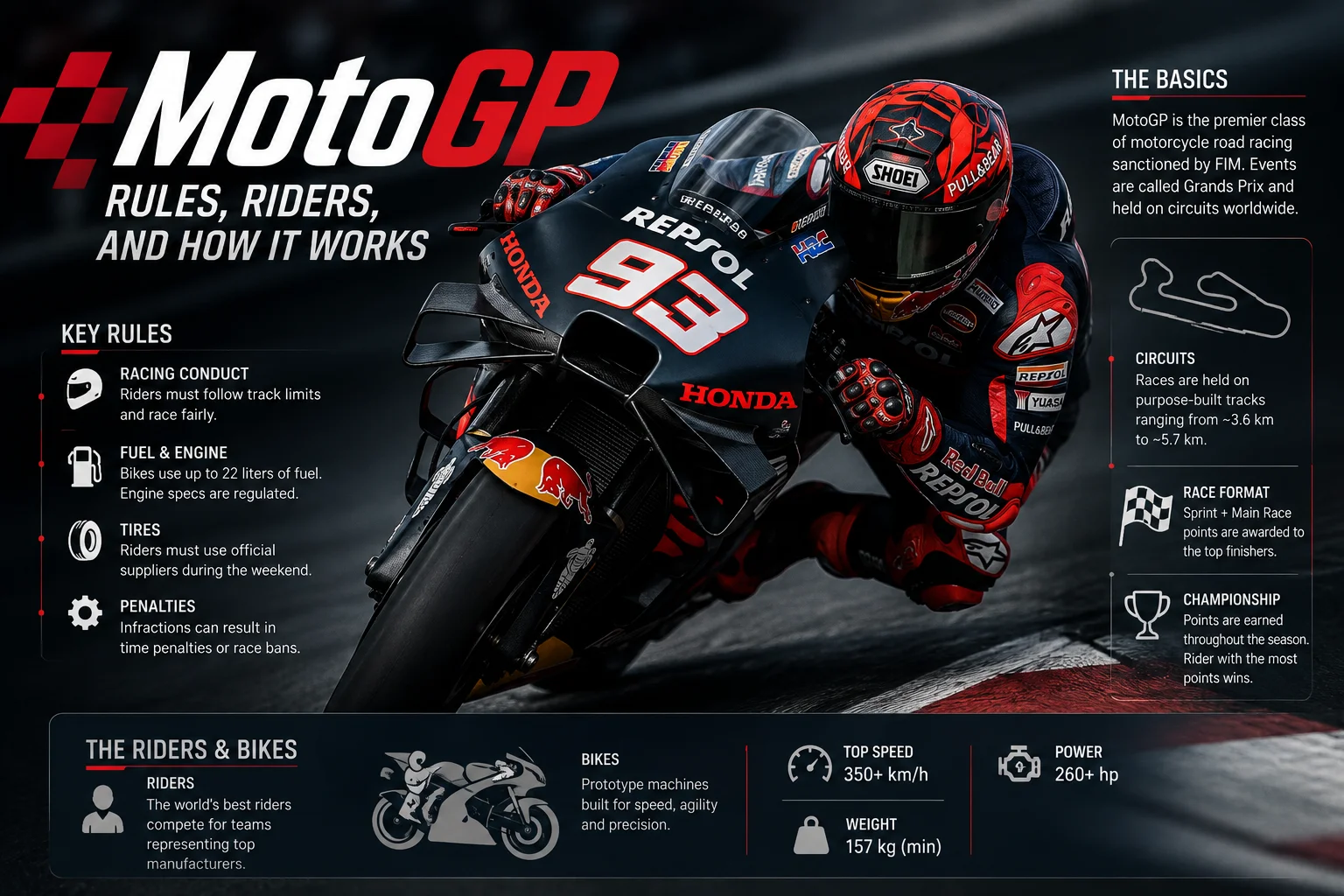
MotoGP is the premier class of Grand Prix motorcycle racing, where the fastest prototype motorcycles on the planet reach speeds most road cars can only dream of, ridden by athletes whose reflexes and courage push the limits of what's physically possible on two wheels. Every corner is a battle of braking, lean angle, and split-second decision-making, and every straight is a demonstration of raw engineering power. What makes MotoGP genuinely unique is the technology packed into these machines: prototype electronics, carbon-fiber components, and aerodynamics developed specifically for racing, none of which exist on any showroom motorcycle. This guide breaks down exactly how MotoGP works — the rules, scoring, bike specifications, rider equipment, records, and the pathway a rider takes to reach the championship's top level.
What Is MotoGP?
MotoGP is the top tier of Grand Prix motorcycle racing, organized by the FIM (Fédération Internationale de Motocyclisme) and operated commercially by Dorna Sports. It sits above two feeder classes — Moto2 and Moto3 — which riders typically climb through before reaching the premier class.
| Class | Engine/Concept | Main Purpose |
|---|---|---|
| MotoGP | Prototype racing motorcycles, 1000cc four-stroke engines | Premier class |
| Moto2 | Prototype chassis with a standardized engine specification | Intermediate class |
| Moto3 | Lightweight prototype motorcycles | Entry-level class |
Unlike production-based racing series, MotoGP bikes are true prototypes — purpose-built machines that exist nowhere else, developed exclusively for competition by manufacturers including Ducati, Yamaha, Honda, KTM, and Aprilia. Each manufacturer fields a factory team plus supported satellite teams, and riders compete for the individual Riders' Championship, while manufacturers and teams chase their own separate titles across the season. Because of this manufacturer investment and the sheer performance ceiling of the machinery, MotoGP is widely regarded as one of the most technically demanding and physically dangerous forms of motorsport in the world.
How Does MotoGP Work?
A typical MotoGP race weekend follows a structured format designed to set the grid and determine the champions across a full season.
- Practice sessions – Friday and Saturday morning sessions let riders and teams fine-tune setup and gather data.
- Qualifying – A knockout-style session (Q1 and Q2) determines starting grid positions for both the Sprint and the Grand Prix.
- Sprint – A shorter Saturday afternoon race, roughly half the distance of the full Grand Prix, that awards a reduced points scale.
- Grand Prix race – The main Sunday race, run over the full race distance and awarding the largest points haul of the weekend.
- Championship points – Points from every Sprint and Grand Prix accumulate across the season.
- Rider championship – Awarded to the rider with the most cumulative points at season's end.
- Constructor championship – Awarded based on the best-placed rider from each manufacturer at every race.
- Team championship – Combines the points of both riders from each team.
The Sprint format, introduced to add more race action to each weekend, is a shorter, standalone race with its own points allocation, separate from the Sunday Grand Prix, giving riders two chances each weekend to score championship points.
MotoGP Rules Explained
MotoGP's rulebook is extensive, but here's what an average fan actually needs to understand the racing:
- Race starts: Riders line up on the grid in qualifying order and take a rolling start once the lights go out.
- Grid positions: Determined by qualifying times, with the fastest riders starting at the front.
- Overtaking: Allowed anywhere on track, provided riders don't gain an unfair advantage by exceeding track limits.
- Track limits: Riders must keep at least part of the bike within the track's white lines; repeated violations bring penalties.
- Yellow flags: Signal danger ahead — overtaking is prohibited in that section until the danger has passed.
- Red flags: Stop the session entirely, usually due to a serious incident or unsafe conditions.
- Black flags: Order a specific rider to enter the pits and retire, typically for a serious rule breach or a dangerous mechanical issue.
- Penalties: Range from time penalties to grid drops, depending on the severity of the infringement.
- Long-lap penalties: Require a rider to take a designated slower loop off the racing line, costing valuable time without stopping the race.
- Ride-through penalties: Require a rider to pass through the pit lane at reduced speed without stopping.
- Technical regulations: Cover engine displacement, minimum weight, and permitted aerodynamic devices.
- Tire regulations: All teams use a single official tire supplier, with a limited allocation of compounds per weekend.
- Fuel limitations: Bikes must complete the race within a fixed fuel allowance, encouraging efficient engine management.
- Bike changes: Permitted in specific circumstances, such as changing weather conditions requiring wet-weather machines.
- Safety procedures: Include mandatory medical checks after crashes and strict paddock and pit lane speed limits.
- Race interruptions: Can result in a restarted race, a reduced-distance race, or in rare cases, a race being declared complete early.
How Does MotoGP Scoring Work?
Points are awarded to the top finishers in both the Grand Prix and the Sprint, though the Sprint pays out a reduced scale to the top nine finishers.
| Position | Grand Prix Points |
|---|---|
| 1st | 25 |
| 2nd | 20 |
| 3rd | 16 |
| 4th | 13 |
| 5th | 11 |
| 6th | 10 |
| 7th | 9 |
| 8th | 8 |
| 9th | 7 |
| 10th | 6 |
| 11th | 5 |
| 12th | 4 |
| 13th | 3 |
| 14th | 2 |
| 15th | 1 |
Sprint points follow a similarly structured but reduced scale, paid out to the top nine finishers. A rider's total across every Grand Prix and Sprint of the season determines the final standings. The rider with the most points when the season concludes is crowned World Champion, while the Constructor and Team championships are calculated separately using best-placed-rider and combined-rider-points systems, respectively.
How Fast Do MotoGP Bikes Go?
MotoGP bikes are the fastest machines in motorcycle racing. As of the 2026 season, the official outright top-speed record stands at 368.6 km/h (229.0 mph), set by Jorge Martin aboard an Aprilia during practice at the Italian Grand Prix at Mugello — beating the previous record of 366.1 km/h set by KTM riders in 2023 and 2024.
That figure represents a peak speed trap reading, not a typical racing speed. In actual race conditions, top speeds commonly sit above 360 km/h (223 mph) on the fastest circuits, though average speeds across a full lap are considerably lower once braking zones and corners are factored in. Several elements combine to produce these speeds:
- Aerodynamics: Winglets and fairings are engineered to balance straight-line speed against downforce for cornering stability.
- Gear ratios: Tuned specifically for each circuit's straights and corner sequences.
- Engine power: Modern 1000cc engines produce extreme horsepower relative to their size.
- Track layout: Long straights, like Mugello's, are essential for reaching outright top-speed figures.
- Tire conditions: Fresh, warm tires allow riders to commit fully to acceleration zones.
- Rider position: Riders tuck tightly behind the fairing to reduce drag on the fastest sections.
- Slipstreaming: Drafting behind another rider can add several extra km/h in race conditions.
How Much Horsepower Does a MotoGP Bike Have?
Manufacturers don't officially publish exact horsepower figures for their MotoGP prototypes, but based on independent estimates and engine specifications, modern MotoGP bikes are believed to produce somewhere in the region of 280–300 horsepower, generated by 1000cc four-cylinder engines revving to roughly 18,000 rpm.
That said, horsepower alone doesn't determine performance. Torque delivery, electronic rider aids, aerodynamic efficiency, tire grip, overall bike weight, and rider skill all play just as significant a role in how that power actually translates into lap time. A bike with slightly less peak horsepower but better corner-exit traction and aerodynamic efficiency can easily outperform a more powerful rival on a technical circuit.
How Much Does a MotoGP Bike Weigh?
MotoGP technical regulations set a minimum bike weight of 157 kg, a figure that applies to the motorcycle alone and does not include the rider. Notably, MotoGP is the only Grand Prix class that has no combined minimum weight rule for bike and rider together — a system that does exist in both Moto2 and Moto3.
Manufacturers build to this minimum wherever possible, since a lighter bike accelerates faster, brakes later, and changes direction more easily. To reach these weights while surviving extreme racing stresses, teams rely on advanced materials including carbon-fiber bodywork and fairings, along with lightweight alloys throughout the chassis and components. Weight and its distribution directly affect acceleration, braking stability, and how quickly a bike can be tipped into a corner — all of which matter enormously at the level MotoGP riders compete.
How Much Does a MotoGP Bike Cost?
There's no simple sticker price for a MotoGP motorcycle, because these bikes are prototypes, not consumer products. Manufacturers don't sell them and generally don't publish a total build cost, since the real expense is spread across an entire season of ongoing research and development rather than a single unit price.
What drives the cost is the sheer scope of engineering behind each bike:
- Continuous engine development and testing across a season
- Custom carbon-fiber chassis and bodywork components
- Prototype electronics and rider-aid software
- Wind-tunnel-developed aerodynamics
- Bespoke suspension systems
- High-performance carbon brakes
- Extensive data acquisition and telemetry systems
- Large engineering and trackside technical staff
- A constant supply of spare parts and replacement components
- Off-season and in-season testing programs
Because of this, any number presented online as a fixed "MotoGP bike price" should be treated as speculation rather than an official manufacturer figure — teams and factories simply don't disclose a per-bike cost.
What Are the Things MotoGP Riders Wear on Their Hands?
MotoGP riders wear specialized racing gloves engineered specifically for the extreme demands of top-level motorcycle racing. These gloves combine protection with the fine control needed to operate the brake and throttle at the limit.
Key features include:
- Leather construction: Premium leather provides abrasion resistance in the event of a crash.
- Knuckle protection: Hard external armor shields the knuckles from impact.
- Finger protection: Reinforced stitching and structure protect against hyperextension and abrasion.
- Palm protection: Sliders built into the palm reduce friction if a rider's hand contacts the track.
- Wrist protection: Secure closures and sometimes rigid wrist supports help prevent injury during a fall.
- Reinforcement: Key stress points are double-stitched or armored for durability under extreme loads.
- Suit connection: Many gloves connect directly to the racing suit for a fully integrated, seamless protective system.
Despite all this protection, gloves are designed to preserve enough sensitivity for riders to feel precise brake and throttle inputs — an essential balance in a sport where fractions of a second matter.
What Helmets Do MotoGP Riders Wear?
Every MotoGP rider wears a full-face racing helmet built to the highest safety standards in motorcycle sport, and these helmets differ significantly from typical road helmets in both construction and performance.
- Full-face design: Complete coverage protects the head, chin, and jaw in a crash.
- Advanced impact protection: Multi-density internal shells are engineered to absorb and disperse impact energy.
- Visors: Optically precise, scratch-resistant visors offer clear vision at extreme speeds and are designed with quick-release, tear-off systems for track debris.
- Aerodynamic design: Shaped to minimize drag and buffeting at speeds exceeding 300 km/h.
- Ventilation: Engineered airflow channels help manage heat and rider fatigue during long races.
- Safety certification: Helmets must meet strict FIM and racing safety homologation standards before they're permitted on track.
- Custom graphics: Riders typically use personalized helmet designs, often refreshed for specific races or milestones.
Several manufacturers supply helmets across the MotoGP grid, and no single brand is used universally — riders choose based on personal fit, sponsorship, and safety certification rather than any single mandated supplier.
MotoGP Rider Safety Equipment
Beyond gloves and helmets, MotoGP riders wear a complete protective system designed for the unique risks of racing at extreme lean angles and speed.
| Equipment | Main Purpose |
|---|---|
| Helmet | Head protection |
| Racing suit | Body and abrasion protection |
| Airbag system | Impact protection |
| Gloves | Hand protection |
| Boots | Foot and ankle protection |
| Back/chest protection | Upper-body protection |
Leather racing suits are typically one-piece and reinforced at high-impact zones like the shoulders, elbows, and knees, often with sliders to manage contact with the track. Built-in airbag systems, now mandatory across the grid, deploy in milliseconds during a crash to protect the collarbone, chest, and back — one of the most significant safety advances in the sport's recent history. This full protective system reflects just how specialized MotoGP racing gear has become compared to typical road-riding equipment.
Is MotoGP Faster Than F1?
This is a genuinely nuanced question, because "faster" depends heavily on what's being measured.
| Feature | MotoGP | Formula 1 |
|---|---|---|
| Vehicle type | Prototype motorcycle | Single-seat racing car |
| Top speed | Very high | Very high |
| Acceleration | Extremely rapid | Extremely rapid |
| Cornering | Motorcycle dynamics | Four-wheel aerodynamics |
| Braking | Extremely demanding | Extremely powerful |
| Power-to-weight | Exceptional | Exceptional |
In pure outright top speed, the two are actually close — MotoGP's record sits at 368.6 km/h, while Formula 1's all-time recorded top speed, set during 2016 qualifying in Azerbaijan, reached roughly 378 km/h. That's a relatively narrow gap given how different the two vehicles are.
Where F1 pulls decisively ahead is cornering speed and overall lap time. A car with four contact patches and enormous aerodynamic downforce can carry vastly more speed through corners than a motorcycle balanced on two narrow tire contact patches and a lean angle. Braking performance is also extreme in both categories, but F1's braking forces are generally higher thanks to the car's mass, tire contact, and aero-assisted grip. In short: MotoGP bikes can nearly match F1 cars in a straight line, but a Formula 1 car is significantly faster around a full lap of the same circuit.
How Much Do MotoGP Riders Make?
MotoGP rider earnings vary enormously, and exact contract figures are rarely made official by teams or manufacturers. Reported figures vary significantly depending on the source, but they generally include:
- Base salary: Paid directly by the team or manufacturer.
- Performance bonuses: Tied to results such as podiums or top-ten finishes.
- Race-winning bonuses: Additional payments for Grand Prix or Sprint victories.
- Championship bonuses: Substantial payouts for winning the title.
- Sponsorships: Personal sponsorship deals separate from team contracts.
- Personal endorsements: Brand partnerships built around a rider's individual profile.
- Appearance and commercial agreements: Additional income from media and promotional commitments.
At the very top of the grid, published estimates for 2026 suggest the highest-paid riders earn base salaries reported in the range of roughly $15–20 million per year, with multiple sources placing reigning champion Marc Márquez as the highest-paid rider in the paddock. Further down the grid, satellite and rookie riders often earn a small fraction of that, with reported base salaries in the low six figures or, in some cases, riders bringing personal sponsorship to secure a seat. These numbers should be treated as informed estimates rather than confirmed official figures, since teams do not typically disclose contract details publicly.
Who Has the Most MotoGP Championships?
This question requires an important distinction: premier-class titles (500cc-era and modern MotoGP-class titles combined) versus total Grand Prix World Championships across all classes (including smaller categories like 125cc, 250cc, Moto2, and Moto3).
In the premier class specifically, Giacomo Agostini holds the all-time record with eight titles, won largely during a dominant run from 1966 to 1972 and adding an eighth in 1975. Valentino Rossi sits second with seven premier-class titles, and as of the end of the 2025 season, Marc Márquez has equaled Rossi with seven premier-class titles of his own, sealed after a remarkable comeback season with Ducati — leaving him just one title behind Agostini's all-time record heading into the 2026 season.
When counting championships across every Grand Prix class (not just the premier class), the picture changes: Agostini's total climbs to 15 championships, the most of any rider in the sport's history, with Ángel Nieto second on 13. Rossi and Márquez are tied for third on the all-time cross-class list with nine championships each, once their lower-class titles are included alongside their premier-class crowns.
Top MotoGP Riders and Greatest Champions
Judged by championships, race wins, and overall influence on the sport, a handful of names consistently define the conversation about MotoGP's greatest-ever riders.
- Giacomo Agostini (Italy): Eight premier-class titles and 15 championships overall — the most decorated rider in Grand Prix motorcycle racing history, with a win rate that remains statistically the best of any rider given the shorter seasons of his era.
- Valentino Rossi (Italy): Seven premier-class titles and a record 89 premier-class race wins, spanning a career from 2000 to 2017 that helped globalize the sport's popularity.
- Marc Márquez (Spain): Seven premier-class titles as of the end of 2025, the most pole positions in premier-class history, and a career defined by an extraordinary comeback after several serious injuries.
- Mick Doohan (Australia): Five consecutive 500cc titles through the mid-to-late 1990s, with a podium rate around 69% across his career.
- Jorge Lorenzo (Spain): Multiple premier-class titles across two different manufacturers, known for his precise, high-corner-speed riding style.
This isn't a definitive ranked "top five" so much as a list of riders whose championship records and race-winning statistics place them clearly above the pack in the sport's history.
MotoGP World Records and Major Achievements
| Record | Rider | Achievement |
|---|---|---|
| Most premier-class titles | Giacomo Agostini | 8 titles |
| Most premier-class race wins | Valentino Rossi | 89 wins |
| Most premier-class pole positions | Marc Márquez | 75 poles (through 2025) |
| Most championships across all classes | Giacomo Agostini | 15 titles |
| Official top-speed record | Jorge Martin | 368.6 km/h (229.0 mph), 2026 Italian GP |
| Youngest premier-class champion | Marc Márquez | Won his first premier-class title at age 20 in 2013 |
These figures reflect verified statistics current through the 2026 season, though records like top speed and pole positions can shift race to race as the current generation of riders continues competing.
How to Become a MotoGP Racer
Reaching MotoGP is one of the hardest achievements in professional sport, and the pathway is long, structured, and requires far more than raw talent alone.
- Learn motorcycle racing through legitimate, supervised junior racing programs and academies.
- Start competing in age-appropriate junior-level championships on proper racing equipment.
- Develop core riding technique and racecraft under qualified coaching.
- Participate in recognized national or regional racing championships to build a competitive record.
- Build consistent results and visibility within the junior racing scene.
- Progress through professional junior categories, such as feeder series aligned with Moto3.
- Seek out teams, manufacturer academies, and development programs that scout young talent.
- Progress step by step through Moto3, then Moto2, before potentially reaching MotoGP itself.
Becoming a professional racer demands far more than raw speed. It requires natural talent, structured training, elite physical fitness, discipline, quality coaching, real competitive experience, and often significant financial or sponsorship support to fund a young rider's climb through the categories. Motorcycle racing at every level should always be learned in organized, supervised, properly equipped environments — never through unsupervised riding or street racing, which carries serious, unnecessary risk.
MotoGP Bikes vs Normal Motorcycles
A MotoGP motorcycle bears little resemblance to anything sold in a dealership, despite sharing a superficial silhouette with sport bikes.
| Feature | MotoGP Bike | Road Motorcycle |
|---|---|---|
| Purpose | Professional racing | Road use |
| Production | Prototype | Mass-produced |
| Aerodynamics | Advanced racing aero | Road-focused |
| Electronics | Highly specialized | Consumer-oriented |
| Brakes | Racing specification | Road specification |
| Tires | Racing slicks | Road tires |
| Cost | Extremely high development cost | Wide consumer range |
While manufacturers often use MotoGP as a proving ground for technology that eventually trickles down into road bikes — traction control systems and advanced electronics being prime examples — a current MotoGP motorcycle itself is a specialized, one-off prototype, built specifically for racing and never intended for public sale or road use.
Why MotoGP Bikes Are So Technologically Advanced
MotoGP prototypes represent the cutting edge of motorcycle engineering, packed with technology that simply doesn't exist on production machines.
- Aerodynamic winglets: Small wing-like surfaces generate downforce, helping keep the front wheel planted under hard acceleration.
- Carbon brakes: Extremely lightweight and powerful, though they require specific operating temperatures to work effectively.
- Advanced electronics: Traction control, wheelie control, and engine-braking software manage power delivery in real time.
- Ride-height devices: Systems that lower the bike's center of gravity during acceleration to reduce wheelies and improve traction (permitted under current regulations).
- Data acquisition: Sensors continuously feed information back to engineers for real-time and post-session analysis.
- Traction management: Software adjusts power delivery instantly based on rear-wheel grip.
- Engine braking control: Software-managed deceleration helps stabilize the bike entering corners.
- Launch control: Assists riders in getting off the line as efficiently as possible at race starts.
- Advanced suspension: Highly tunable systems adapt to each circuit's specific demands.
- Prototype tires: Developed specifically for racing loads, temperatures, and grip levels far beyond road tire specifications.
- Lightweight materials: Carbon fiber and advanced alloys are used extensively to meet minimum weight targets without sacrificing strength.
Each of these systems represents years of manufacturer investment, and together they explain why MotoGP bikes perform at a level so far beyond anything available to the public.
Frequently Asked Questions About MotoGP
Q:How fast can a MotoGP bike go?
The official all-time top-speed record is 368.6 km/h (229.0 mph), set by Jorge Martin at the 2026 Italian Grand Prix. In race conditions, bikes commonly reach speeds above 360 km/h on the fastest circuits.
Q:How much horsepower does a MotoGP bike have?
Manufacturers don't officially publish exact figures, but independent estimates suggest modern MotoGP bikes produce somewhere around 280–300 horsepower from their 1000cc engines.
Q:How much does a MotoGP bike weigh?
The minimum weight is 157 kg for the bike alone, not including the rider. MotoGP is the only Grand Prix class without a combined bike-and-rider minimum weight rule.
Q:Is MotoGP faster than Formula 1?
It depends on what's measured. MotoGP's top speed (368.6 km/h) is close to F1's all-time top speed (roughly 378 km/h), but F1 cars are significantly faster through corners and over a complete lap due to four-wheel grip and downforce.
Q:How much does a MotoGP bike cost?
There's no official published price, since MotoGP bikes are prototypes rather than commercial products. The real cost lies in ongoing research, development, and engineering across a full season rather than a single build price.
Q:Who has won the most MotoGP championships?
Giacomo Agostini holds the record with eight premier-class titles. Valentino Rossi and Marc Márquez are tied for second with seven each, as of the end of the 2025 season.
Q:What helmets do MotoGP riders wear?
Riders wear full-face racing helmets built to strict FIM safety standards, featuring advanced impact protection, optically precise visors, and aerodynamic shaping. No single brand is used across the entire grid.
Q:What do MotoGP riders wear for protection?
A complete system including a helmet, reinforced leather racing suit, built-in airbag system, racing gloves, boots, and back/chest protection, all engineered specifically for high-speed motorcycle racing.
Q:How much do MotoGP riders make?
Reported figures vary significantly. Top riders are estimated to earn base salaries in the range of $15–20 million per year including bonuses, while riders further down the grid may earn a small fraction of that.
Q:Can anyone become a MotoGP racer?
In theory yes, but in practice it requires exceptional talent, years of structured training through supervised junior racing categories, financial or sponsorship backing, and a gradual climb through Moto3 and Moto2 before reaching MotoGP.
Be the first to comment!