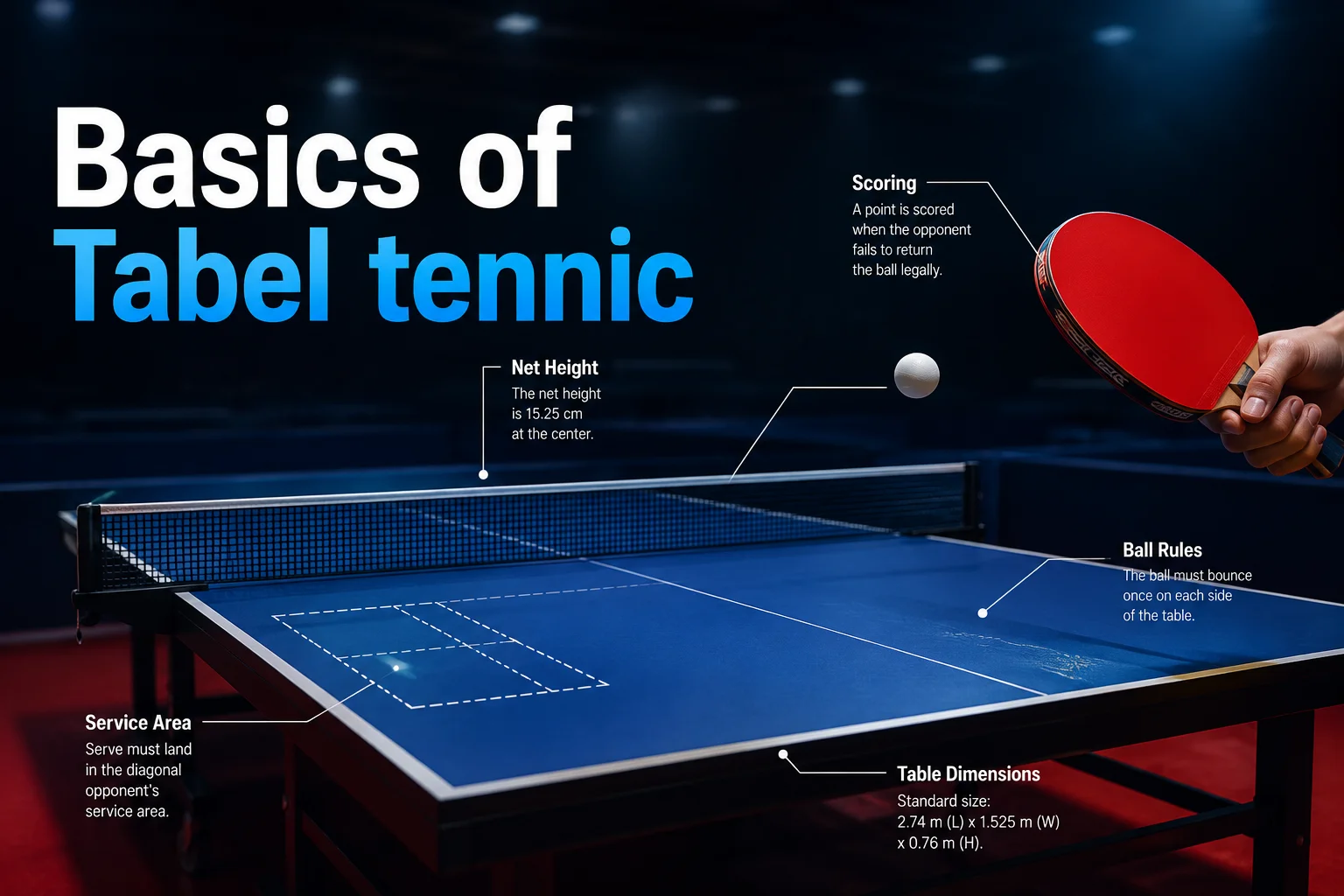
Table tennis is one of the fastest reaction sports in the world, played on a small table with a lightweight ball that can travel at surprising speed between two paddles. Commonly called ping pong, it started as a living-room pastime and grew into a global Olympic event followed in more than 200 countries. Its mix of quick footwork, spin, and split-second decision-making makes it just as fun to watch as it is to play. This guide walks through everything a beginner needs to know: how table tennis started, the official rules and scoring system, table and equipment specifications, how it differs from lawn tennis, and the players who have defined the sport at its highest level.
What Is Table Tennis?
Table tennis is a racket sport played on a hard table divided by a net, where two players (singles) or four players (doubles) hit a lightweight ball back and forth using small paddles called rackets or bats. The objective is simple: hit the ball over the net so it lands on your opponent's side in a way that makes it difficult, or impossible, for them to return it legally.
Each rally starts with a serve, and points are scored whenever a player fails to return the ball correctly. What looks simple on the surface is actually a demanding test of speed, spin, reflexes, and positioning. Top players can generate ball speeds that leave almost no time to react, which is why anticipation and footwork matter as much as raw power. Because the equipment is compact and the game can be played indoors in a small space, table tennis has become one of the most accessible racket sports for beginners of any age.
When Did Table Tennis Start? A Brief History of Table Tennis
Table tennis began as an after-dinner parlour game in late 19th-century England, where upper-class households improvised with everyday items — books stacked as a net, cigar box lids as paddles, and champagne corks or rounded chunks of cork as balls. The game mimicked lawn tennis in miniature and was popular as an indoor activity when outdoor courts weren't practical.
As the game caught on commercially, manufacturers introduced celluloid balls and branded sets, and it briefly took the trade name "Ping-Pong" before the name "table tennis" was formally adopted in the early 1920s. The turning point for organized competition came in December 1926, when representatives from England, Germany, Hungary, Sweden, Austria, Czechoslovakia, Denmark, India, and Wales founded the International Table Tennis Federation (ITTF) in London, with the first World Championships held that same year. From there, the sport spread rapidly across Europe before Asian nations — first Japan, then China and South Korea — began reshaping the game with faster, more attacking styles from the 1950s onward.
Table tennis made its Olympic debut at the 1988 Seoul Games, cementing its place as a truly global sport. Since then, competitive play has continued to evolve, including a shift from 21-point to 11-point games in 2001 and a change from 38mm to 40mm balls in 2000 to slow the game slightly for spectators.
| Period/Year | Major Development |
|---|---|
| Late 19th century | Indoor parlour version of the game develops in England |
| 1921–22 | The name "table tennis" is formally adopted |
| 1926 | ITTF founded in London; first World Championships held |
| 1950s onward | Asian nations rise to dominance with faster attacking styles |
| 1988 | Table tennis debuts as an official Olympic sport in Seoul |
| 2000–2001 | Ball size increases to 40mm; scoring changes to 11-point games |
Ping Pong Rules
Understanding the core rules makes table tennis far more enjoyable to watch and play. Here are the fundamentals every beginner should know:
- Starting the rally – Play begins with a legal serve, and the ball must stay in continuous play until a point is decided.
- Serving – The server tosses the ball and strikes it so it bounces once on their own side, clears the net, and lands on the opponent's side.
- Returning the ball – After the serve, players must return the ball directly over or around the net onto the opponent's side after it bounces once on their own side.
- Legal and illegal shots – Hitting the ball before it bounces on your side (a volley) is illegal during normal play; the paddle hand touching the table while in contact with the ball is also a fault.
- Let situations – If a serve clips the net but still lands correctly in the service area, it's a "let" and is replayed without penalty.
- Net-related situations – Any other ball that touches the net during a rally (not on serve) but continues over is still in play.
- Singles rules – Players must serve to any part of the opponent's half of the table.
- Doubles rules – Partners must serve diagonally and alternate hitting the ball, taking turns after each point.
- How points are won – A point is awarded when the opponent fails to make a legal return, serves illegally, or the ball goes out of play.
- Games and matches – A game is played to 11 points (win by 2), and a match is typically the best of 5 or 7 games in competitive play.
Rules to Serving in Ping Pong
Serving looks easy but has strict requirements that many beginners overlook. Understanding the rules to serving in ping pong is essential to avoid illegal serves that cost points.
- Ball placement: The ball must rest freely on an open, flat palm before the toss — it cannot be spun or hidden in the fingers.
- Toss requirements: The server must toss the ball near-vertically at least 16 centimeters (about 6 inches) before striking it.
- Ball visibility: The ball must remain visible to the opponent throughout the toss and strike; serving from behind the body or blocking the view is illegal.
- Contact with the ball: The server must strike the ball as it descends, behind their own end of the table.
- Trajectory: A legal serve bounces once on the server's side, clears or grazes the net (a let is replayed), and then bounces on the opponent's side.
- Service area: In singles, the ball can land anywhere on the opponent's half; in doubles, it must bounce diagonally into the receiver's right-hand service box.
- Net touches: If the serve clips the net but is otherwise legal, it's replayed with no point awarded either way.
- Common mistakes: Hiding the toss, tossing too low, or making contact in front of the table are among the most frequent faults called on beginners and even club-level players.
How Does Scoring Work in Table Tennis?
Modern table tennis uses an 11-point scoring system. A player wins a game by reaching 11 points first, provided they lead by at least 2 points. If the score reaches 10–10 (deuce), play continues until one player establishes a two-point lead.
Matches are typically played as the best of 5 games (first to win 3) in casual and lower-level competitive play, or best of 7 in top-tier professional events. Service alternates every 2 points during a game, except during deuce, when the serve switches after every single point. In the deciding game of a match, players also switch ends once one side reaches 5 points, to balance any advantages from lighting or background conditions.
Example: If the score reaches 10–10, a player must lead by two points to win the game — so an 11–10 lead isn't enough; the game would continue to 12–10, 13–11, or beyond until someone pulls two points clear.
Table Tennis Table Ping Pong Table
A regulation table tennis table ping pong table is a rigid, flat playing surface split into two equal courts by a low net running across the middle. The surface is engineered for a consistent, predictable bounce, which is essential at higher levels of play where spin and speed leave little margin for error.
Key things beginners and buyers should know:
- Playing surface: Usually made of dense particleboard or MDF, finished with a smooth, matte coating to reduce glare.
- Net and posts: The net sits at a fixed height across the table's width, held by clamp-mounted posts.
- Construction: Competition tables use a thicker board (typically 25mm) for a truer, more consistent bounce, while recreational tables often use thinner boards.
- Indoor vs outdoor: Indoor tables prioritize surface consistency; outdoor tables are built with weatherproof materials to handle sun and moisture.
- Surface quality: A well-finished, non-glossy surface reduces unwanted glare and helps with ball visibility during fast rallies.
- Bounce consistency: Table thickness and surface density directly affect how true and consistent the ball's bounce feels during play.
Ping Pong Table Size
Every regulation table follows a standard set of dimensions established by the ITTF for fair, consistent competitive play.
| Specification | Standard Measurement |
|---|---|
| Length | 2.74 m |
| Width | 1.525 m |
| Height | 0.76 m |
| Net height | 15.25 cm |
These are official competition dimensions used at ITTF-sanctioned events and most club-level tournaments. Recreational or "mini" tables sold for home use sometimes shrink these dimensions slightly to fit smaller spaces, but they won't be suitable for regulated competitive play.
Standard Size of a Table Tennis
The standard size of a table tennis table isn't arbitrary — it's designed to balance rally speed with fair play, giving skilled players enough surface to generate spin and placement without making rallies too easy to end. Regulation dimensions matter most for players progressing into club or tournament competition, since practicing on an undersized table can throw off shot judgment and footwork spacing.
Beyond the table itself, players need adequate space around it. Competitive venues generally require several meters of clearance on all sides to accommodate the wide-ranging footwork used in defensive and counter-attacking play. For home use, a full-size table remains the better long-term investment if a player intends to compete, while smaller tables are fine for casual, recreational rallies.
Ping Pong Table Tennis Balls
Ping pong table tennis balls are lightweight, hollow spheres, and even small differences in their quality noticeably affect how a rally feels.
- Size: Regulation balls measure 40mm in diameter.
- Weight: Standard balls weigh 2.7 grams.
- Material: Modern balls are made from ABS plastic rather than the older celluloid material, following an ITTF-driven material shift for safety and consistency reasons.
- Recreational vs competition quality: Cheaper balls often have inconsistent roundness or seams, which affects bounce predictability, while competition-grade balls are manufactured to tighter tolerances.
- Star ratings: Balls are often labeled with a star rating (commonly up to three stars), with three-star balls meeting the standard used in official competition.
- Why quality matters: A ball that isn't perfectly round or balanced can wobble mid-flight, making spin and placement far less predictable — a major issue at higher skill levels.
Racket in Table Tennis
A racket in table tennis (also called a paddle or bat) is made up of a few key components that together determine how the ball responds to spin, speed, and control.
- Blade: The wooden (or wood-composite) base of the racket, which affects overall stiffness and speed.
- Rubber: The textured sheet covering each side of the blade, largely responsible for grip and spin generation.
- Sponge: A layer beneath the rubber that adds cushioning and power to each shot.
- Grip styles: The two dominant styles are the shakehand grip (similar to shaking hands, popular internationally) and the penhold grip (common in East Asian playing styles).
- Racket types: Pre-made rackets suit beginners, while intermediate and advanced players often assemble custom combinations of blade and rubber.
- What beginners should look for: A balanced, all-round rubber and a medium-speed blade make it easier to learn consistent strokes before specializing in an aggressive or defensive style.
Foldaway Table Tennis
Foldaway table tennis tables are designed with a hinged frame that lets one or both halves fold upright, making them practical for homes, garages, or shared spaces where a permanently set-up table isn't realistic. Once folded, most models roll away on built-in wheels, freeing up floor space between sessions.
These tables typically include locking mechanisms to keep the frame stable during folding and storage, along with safety features to prevent accidental collapse. While foldaway tables offer real convenience, most recreational and mid-range models don't match the surface density or bounce consistency of dedicated, non-folding competition tables — a worthwhile tradeoff for casual players but a limitation for anyone training seriously.
Outdoor Table Tennis Ping Pong
Outdoor table tennis ping pong tables are built differently from their indoor counterparts, since they need to withstand sun exposure, rain, and temperature swings without warping. Manufacturers typically use weather-resistant materials such as coated aluminum composite or specially treated boards designed to resist moisture absorption, along with UV-resistant paint to prevent fading and surface degradation over time.
Not every outdoor table is fully weatherproof, and coverage varies by brand and construction, so it's worth checking a table's specific rating before leaving it exposed long-term. Outdoor play can also affect the ball and racket — wind interferes with spin and trajectory, and humidity can subtly change how the rubber grips the ball. Despite these tradeoffs, outdoor tables remain popular for parks, community spaces, and backyard setups where a permanent indoor table isn't practical.
Ninja Table Tennis Set
A "ninja table tennis set" generally refers to a themed or branded all-in-one table tennis equipment package aimed at casual and beginner players. Rather than treating this as an endorsement of a specific product, it's worth knowing what to check before buying any bundled set like this:
- Rackets/paddles: Confirm they include a sponge layer rather than bare wood, which affects both comfort and control.
- Balls: Check how many balls are included and whether they're rated for casual or more serious play.
- Net: Make sure the net and its clamp system are compatible with your table's thickness.
- Compatibility: Confirm the set is designed to fit a standard or foldaway table rather than a specific proprietary design.
- Build quality: Look for reviews mentioning durability, since bundled sets vary widely in construction quality.
- Intended use: Themed sets are usually built for casual, recreational play rather than competitive training.
If you're considering a specific current product sold under this name, it's best to check the retailer's current listing directly for accurate specifications, since bundled product details can change between releases.
Ping Pong vs Tennis Table
"Ping pong" and "table tennis" refer to the exact same sport — the terms are used interchangeably, with "ping pong" being the more casual, commonly used name. Tennis, on the other hand, is a completely different sport played on a court rather than a table.
| Feature | Table Tennis | Tennis |
|---|---|---|
| Playing surface | Table | Court |
| Equipment | Small racket and lightweight ball | Tennis racket and larger ball |
| Net | Small raised net on table | Full-size court net |
| Playing area | Table | Tennis court |
| Ball characteristics | Lightweight | Heavier/larger |
| Main movements | Quick reactions and compact movement | Larger court movement |
While both sports share the core idea of hitting a ball over a net, the scale, equipment, and physical demands are entirely different. Table tennis rewards rapid-fire reflexes and wrist control, while tennis relies more on court coverage, endurance, and full-body power.
Top 5 Table Tennis Players of All Time
Ranking the greatest table tennis players comes down to Olympic and World Championship achievements, longevity at world No. 1, and overall influence on the sport. Here are five players whose records and impact stand out most clearly.
| Rank | Player | Country | Key Achievement |
|---|---|---|---|
| 1 | Ma Long | China | 6 Olympic gold medals; first man to win back-to-back Olympic singles titles |
| 2 | Jan-Ove Waldner | Sweden | Career Grand Slam; the most successful non-Chinese player in the sport's history |
| 3 | Deng Yaping | China | 4 Olympic gold medals; ranked world No. 1 for eight consecutive years |
| 4 | Zhang Yining | China | 4 Olympic gold medals; 10 World Championship titles; first player to complete a Double Grand Slam |
| 5 | Wang Nan | China | Most World Championship titles won by a female player prior to Ma Long's career record |
Ma Long (China)
Widely regarded as the greatest table tennis player of all time, Ma Long won six Olympic gold medals across the 2012, 2016, 2020, and 2024 Games (two in singles, four in the team event). At the Tokyo 2020 Olympics, he became the first man in Olympic history to defend his men's singles title. He also won three World Championship singles titles (2015, 2017, 2019) and held the world No. 1 ranking for a record 64 months, including a 34-month unbroken streak. His combination of longevity, singles dominance, and team success has made him the benchmark for the modern era.
Jan-Ove Waldner (Sweden)
Known as the "Mozart of Table Tennis" for his creative, unpredictable playing style, Waldner is the most successful non-Chinese player in the sport's history. He won Olympic singles gold at Barcelona 1992 and two World Championship singles titles, in 1989 and 1997, while also completing a career Grand Slam across the Olympics, World Championships, and World Cup. Waldner remained competitive against Chinese players for an unusually long stretch of his career, earning enormous respect in China itself, where he's affectionately nicknamed "Lao Wa."
Deng Yaping (China)
Deng Yaping dominated women's table tennis through the 1990s, winning four Olympic gold medals in singles and doubles across the 1992 and 1996 Games. She held the world No. 1 ranking for eight consecutive years, an extraordinary run of sustained dominance, and was inducted into the ITTF Hall of Fame in recognition of her impact on the women's game. Despite standing just 1.50 meters tall, her explosive close-to-the-table style and exceptional footwork made her nearly unbeatable during her prime.
Zhang Yining (China)
Zhang Yining was the most dominant female player of the 2000s, winning four Olympic gold medals — singles and doubles at Athens 2004, then singles and team at Beijing 2008 — along with 10 World Championship titles and four World Cup singles titles. She held the world No. 1 ranking for the better part of six years and became the first player of either gender to complete a Double Grand Slam, winning the singles titles at the Olympics, World Championships, and World Cup on two separate occasions.
Wang Nan (China)
Wang Nan built one of the most decorated careers in women's table tennis history, spending 35 months at world No. 1 and winning multiple singles and doubles titles across the World Championships and World Cup. Her consistency across singles, doubles, and team events made her one of the most complete players of her generation, and her World Championship title tally stood as the record for female players until Ma Long's career (across genders) later surpassed it.
Table Tennis Records and Major Achievements
| Record/Milestone | Player | Achievement |
|---|---|---|
| Most Olympic gold medals (any player) | Ma Long | 6 Olympic gold medals across 4 Olympic Games |
| First back-to-back Olympic singles champion (men) | Ma Long | Defended his men's singles title at Tokyo 2020 |
| Longest reign at world No. 1 (men) | Ma Long | 64 months total, including 34 consecutive months |
| First Double Grand Slam (any gender) | Zhang Yining | Won Olympic, World Championship, and World Cup singles titles twice |
| Longest reign at world No. 1 (women) | Deng Yaping | 8 consecutive years as world No. 1 |
| Career Grand Slam, non-Chinese player | Jan-Ove Waldner | Olympic, World Championship, and World Cup gold |
These records span different eras of the sport and reflect different kinds of greatness — from Ma Long's sustained modern dominance to Waldner's rare success against an era defined by Chinese supremacy.
How to Start Playing Table Tennis
- Learn the basic grip — shakehand or penhold — and get comfortable holding the racket naturally.
- Understand the ready position: knees slightly bent, weight forward, racket held in front of the body.
- Practice forehand and backhand shots against a wall or with a partner before worrying about spin.
- Learn the basic serve, focusing on legal toss height and contact point before adding spin.
- Practice returning serves, starting with simple, low-spin serves before facing more advanced ones.
- Learn simple spin control — topspin and backspin are the foundation for almost every shot.
- Play short practice rallies focused on control rather than power.
- Gradually introduce match scoring once basic rallies feel comfortable and consistent.
Why Table Tennis Is Popular Around the World
Table tennis's global popularity comes down to a few clear advantages: it's playable indoors year-round, requires relatively little space, and offers fast, exciting rallies that reward skill over raw strength. Its low barrier to entry makes it accessible to players of nearly any age or fitness level, while its ceiling for technical mastery keeps it competitive and deep at the professional level. Add in its status as an Olympic sport and a packed international tournament calendar, plus a growing number of professional leagues, and it's easy to see why the sport continues to grow its fanbase worldwide.
Frequently Asked Questions About Table Tennis
Q:What are the basic rules of table tennis?
Players serve to start each rally, and the ball must bounce once on each side before being returned. Points are won when an opponent fails to make a legal return, and games are played to 11 points with a two-point winning margin required.
Q:How many points are needed to win a table tennis game?
A player needs 11 points to win a game, but must lead by at least 2 points. If the score reaches 10–10, play continues until one player achieves a two-point advantage.
Q:What is the standard size of a table tennis table?
The official ITTF competition table measures 2.74 meters long, 1.525 meters wide, and 0.76 meters high, with a net height of 15.25 centimeters.
Q:Is ping pong the same as table tennis?
Yes, ping pong and table tennis refer to the same sport. "Ping pong" is simply the more casual, widely used name, while "table tennis" is the sport's official name used in competitive and Olympic contexts.
Q:How many players can play table tennis?
Table tennis is played with either two players in singles matches or four players (two per side) in doubles matches.
Q:What equipment do beginners need for table tennis?
Beginners need a racket (paddle), a supply of regulation 40mm balls, and access to a table with a net. A pre-assembled beginner racket with balanced rubber is usually the easiest starting point.
Q:What is the difference between indoor and outdoor table tennis?
Indoor tables are optimized for consistent bounce and surface quality, while outdoor tables use weather-resistant materials to handle sun and moisture exposure, though playing conditions like wind can affect outdoor rallies in ways indoor play never has to account for.
Be the first to comment!