What Is Baseball?
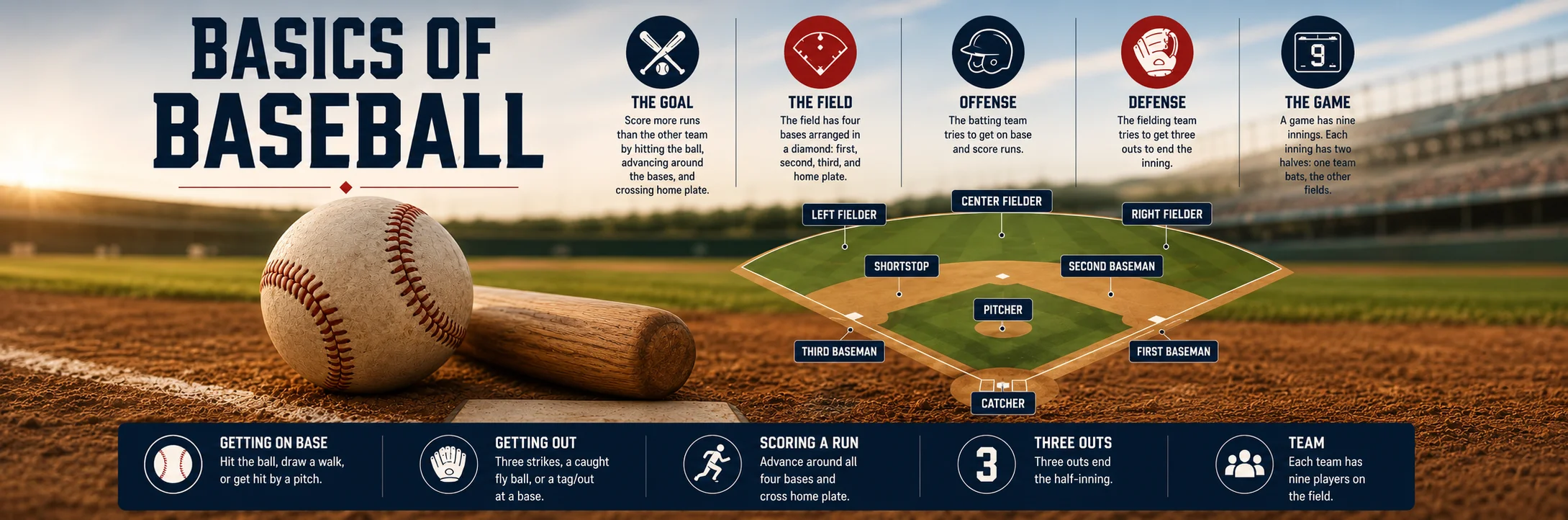
Baseball is a team sport played between two sides of nine players each. One team bats, attempting to score runs, while the other team fields, working to prevent them. The teams alternate roles every half-inning. After nine complete innings, the team with the higher run total wins.
Beneath its straightforward structure lies one of the most strategically rich sports ever created — filled with statistics, tactics, and moments that keep fans engaged from the first pitch to the final out.
How Is a Baseball Game Structured?
A standard MLB game consists of nine innings. Each inning is divided into two halves — the top half, in which the visiting team bats, and the bottom half, in which the home team bats.
During each half-inning, the batting team sends players to the plate one at a time. The objective is to reach base and eventually cross home plate to score a run. The fielding team's goal is to record three outs — once three outs are made, that half-inning ends and the teams switch roles.
If the score is tied after nine innings, the game continues into extra innings until one team holds the lead at the end of a complete inning.
Basic Rules of Baseball
Baseball has a reputation for complexity, but the core rules are easy to follow:
Strikes and Balls — The pitcher throws toward home plate. If the batter swings and misses, or the ball passes through the strike zone without the batter swinging, it is called a strike. Three strikes result in an out. If a pitch misses the strike zone and the batter does not swing, it is called a ball. Four balls award the batter a free advance to first base, known as a walk.
Getting on Base — A batter can reach base by recording a hit (single, double, triple, or home run), drawing a walk, or being struck by a pitch. Once on base, runners attempt to advance toward home plate to score.
Recording an Out — Common ways to record an out include: a strikeout, a fielder catching a batted ball before it touches the ground, or a fielder tagging a baserunner or throwing to a base before the runner arrives.
Scoring a Run — A run is scored when a baserunner successfully advances through all four bases — first, second, third, and home plate. The team with more runs after nine innings wins the game.
How Do Baseball Positions Work?
Each fielding team places nine players on the field, each assigned to a specific position:
- Pitcher — Throws the ball from the pitching mound toward the batter
- Catcher — Positioned behind home plate to receive pitches and direct the defense
- First Baseman, Second Baseman, Third Baseman — Each guards their respective base in the infield
- Shortstop — Covers the area between second and third base; typically one of the most versatile infielders
- Left Fielder, Center Fielder, Right Fielder — Cover the large outfield area beyond the infield
Each position requires a distinct skill set. Pitchers rely on arm strength and precision. Outfielders need speed and throwing range. Infielders require quick reflexes and reliable hands.
Key Baseball Statistics Explained
What Is OPS in Baseball?
OPS stands for On-base Plus Slugging. It is a single number that combines a hitter's ability to reach base with their ability to hit for power — two of the most important offensive skills in the game.
The formula is: OPS = On-Base Percentage (OBP) + Slugging Percentage (SLG)
- An OPS of .900 represents an excellent season
- An OPS above 1.000 places a hitter among the elite performers in the league
OPS is widely used by broadcasters and analysts because it is easy to understand, straightforward to calculate, and highly predictive of run production. For anyone new to baseball statistics, OPS is the best place to start.
What Does RBI Mean in Baseball?
RBI stands for Runs Batted In. It is one of baseball's oldest and most recognized statistics.
A batter earns an RBI whenever their plate appearance directly results in a run scoring — whether through a base hit that brings a runner home, a sacrifice fly, or a multi-run home run. It measures how consistently a hitter produces results with runners on base.
For fantasy baseball, RBI is a core counting statistic. Hitters who bat in the middle of a lineup, with faster runners on base ahead of them, typically accumulate RBIs at a higher rate.
What Is WHIP in Baseball?
WHIP stands for Walks plus Hits per Inning Pitched. It is one of the most important pitching statistics in modern baseball.
The formula is: WHIP = (Walks + Hits) ÷ Innings Pitched
- A WHIP below 1.00 is considered elite
- A WHIP between 1.10 and 1.25 is solid and reliable
- A WHIP above 1.40 suggests a pitcher is frequently allowing baserunners
WHIP matters because most runs are preceded by baserunners. A pitcher who keeps the bases clear forces the opposing team to work much harder to score. It is a standard category in most fantasy baseball leagues and a reliable window into a pitcher's overall effectiveness.
How Many Innings Are in College Baseball?
A standard college baseball game consists of nine innings, the same as MLB. However, there are some notable differences at the NCAA level.
In extra innings, college baseball uses an automatic runner rule: beginning in the 10th inning, each team starts its half-inning with a runner already on second base. This format speeds up the game and reduces stress on pitching rosters.
Doubleheaders in college baseball are often played as seven-inning games, particularly during the regular season when programs are managing workloads across a demanding schedule.
The College World Series, held annually in Omaha, Nebraska, uses the standard nine-inning format for all games and features a double-elimination bracket structure, concluding with a best-of-three championship series.
How Many Players Are on a Baseball Team?
MLB rosters are larger and more flexible than most fans realize.
The standard active roster consists of 26 players (expanded from 25 in 2020). Each team also maintains a 40-man roster of players under contract.
A typical 26-man roster breaks down as follows:
- Starting Pitchers: 5
- Relief Pitchers: 7–8
- Catchers: 2
- Infielders: 5–6
- Outfielders: 4–5
- Designated Hitter: typically filled by a position player
From September 1 onward, rosters expand to 28 players, allowing teams to bring up additional depth for the final stretch of the regular season.
During the playoffs, each team submits a 26-man postseason roster for each series.
How to Break In a Baseball Glove
A brand-new glove is stiff and takes time to prepare properly. Here is the method used by serious players at every level:
- Apply leather conditioner — Use a quality glove conditioner or leather oil and work it into the pocket and laces with a soft cloth. This softens the leather without weakening it.
- Form the pocket — Place a baseball in the glove's pocket, fold the glove around it naturally, and secure it with rubber bands overnight. Repeat several times.
- Play catch regularly — There is no substitute for actual use. Most players find that 10–20 hours of catch is needed to fully shape a glove.
- Avoid shortcuts — Do not use ovens, microwaves, or direct heat sources. Heat dries out leather and causes cracking over time.
- Maintain it seasonally — Condition the glove two to three times per season, store it with a ball in the pocket, and keep it away from direct sunlight.
How to Wash a Baseball Cap
Hand washing is the safest and most recommended method. Use cool water with a small amount of mild detergent, scrub gently with a soft brush — paying attention to the sweatband — then rinse thoroughly and allow to air dry on a rounded surface to preserve the cap's shape.
Machine washing is acceptable for caps made entirely of cotton or polyester. Use a gentle cycle with cold water and place the cap in a mesh laundry bag or cap cage to protect its structure.
Important care tips:
- Never place a cap in the dryer — heat warps the brim and can shrink the material
- Avoid bleach, even on white caps, as it weakens stitching
- Do not machine wash caps with cardboard brims — water will permanently damage them
- Always air dry away from direct sunlight to prevent fading
What Does Tapping Your Helmet Mean in Baseball?
Helmet tapping is part of baseball's rich unwritten culture and serves two distinct purposes.
As a gesture of acknowledgment, players tap their helmets to recognize a teammate's strong play — a sharp base hit, a smart read on the bases, or a heads-up play in the field. It is the modern equivalent of tipping one's cap.
As a coaching signal, third base coaches incorporate helmet touches into their sign sequences to relay instructions to batters and baserunners. Touching the brim, crown, or ear flap can each carry specific coded meanings. Opposing teams study these signals closely, which is why coaching staffs frequently update their sign systems throughout the season.
For ongoing MLB news, player profiles, statistics breakdowns, and fan guides, stay connected with SportifyHQ year-round.

Be the first to comment!