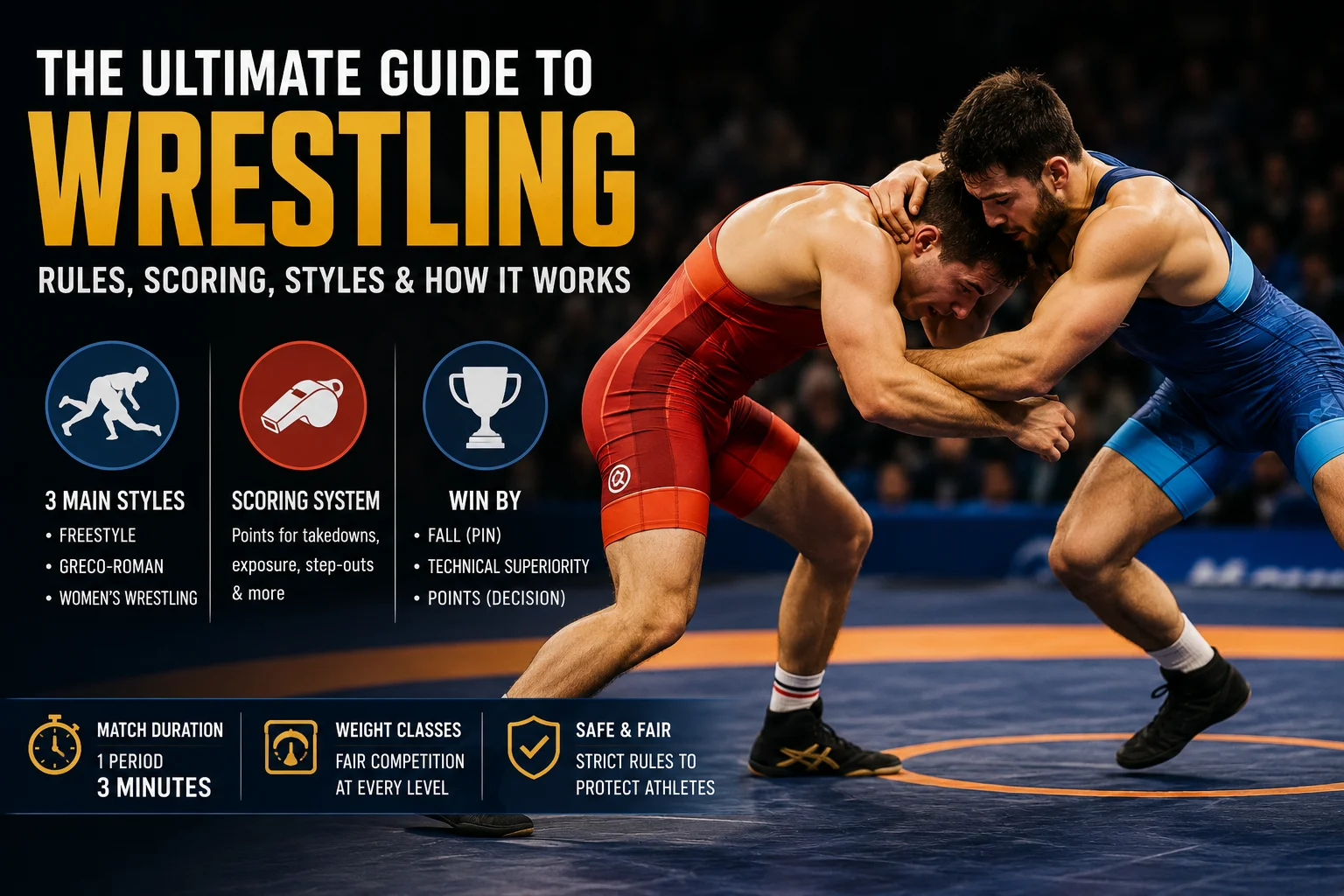
What Is Wrestling?
At its core, wrestling is a combat sport where two athletes try to gain control over each other using grappling techniques — throws, takedowns, holds, and pins — without striking. The sport is governed internationally by United World Wrestling (UWW), which sets the rules for the Olympic disciplines: freestyle, Greco-Roman, and women's wrestling.
The goal is simple on paper: either pin your opponent's shoulders to the mat or outscore them using a points system built around control, exposure, and technical skill.
The Two Main Styles: Freestyle vs Greco-Roman
Wrestling at the international and Olympic level is split into three disciplines, and understanding the difference is the first step to understanding the sport.
- Freestyle Wrestling – Wrestlers can use their legs to attack and defend, and can also attack an opponent's legs. It's the most dynamic style and the one most similar to American collegiate wrestling.
- Greco-Roman Wrestling – Legs cannot be used to attack, defend, or trip an opponent, and wrestlers cannot grab below the waist. It's an upper-body-only discipline that rewards throws and power moves.
- Women's Wrestling – Follows freestyle rules and has been a full Olympic discipline since 2004.
UWW updated several rules ahead of the 2028 Los Angeles Olympic cycle, refining how leg contact is officiated in freestyle and tightening tie-break criteria to reduce passive, stalling wins.
How a Wrestling Match Is Structured
A senior international bout consists of a single period of 3 minutes, wrestled continuously unless a fall, injury, or technical stoppage ends it early. Matches take place on a circular mat, and wrestlers compete within a marked central zone; stepping outside it can cost points.
Before each match, wrestlers "check-in" at their designated weight class, and the bout is overseen by three officials: a referee on the mat, a judge at the table, and a mat chairman who confirms scoring decisions.
How Scoring Works
Points are awarded based on the technique used and the level of control or exposure created. While exact values are periodically adjusted by UWW, the standard framework looks like this:
| Action | Points Awarded |
|---|---|
| Takedown | 2 points |
| Exposure / turn (opponent's back exposed to the mat) | 2 points |
| Step-out (forcing opponent off the mat) | 1 point |
| Big move from standing to danger position | 4–5 points |
| Passivity penalty | 1 point to opponent |
A match can end before time runs out through technical superiority — a point gap of 10 points in freestyle and women's wrestling, or 8 points in Greco-Roman — which stops the bout immediately in favor of the leading wrestler.
Winning by Fall, Technical Superiority, or Points
There are three ways to win a wrestling match:
- Fall (Pin) – Both of the opponent's shoulders are pressed to the mat under control for one continuous second. This ends the match instantly, regardless of the score.
- Technical Superiority – The point gap described above is reached, ending the bout early.
- Decision on Points – If neither wrestler pins the other or reaches technical superiority, the wrestler with the most points when the clock runs out is declared the winner.
If the score is tied, UWW's criteria — the wrestler who scored the highest-value single move, or who scored first — determines the winner.
Weight Classes
Wrestlers compete in fixed weight categories to keep bouts fair. At the senior international level under UWW, there are 10 Olympic and non-Olympic weight classes across each discipline, ranging from 57 kg up to 125 kg in men's freestyle, with equivalent structures for Greco-Roman and women's wrestling. Wrestlers must make weight at an official weigh-in before competing.
Rules and Prohibited Actions
Certain actions are strictly banned to protect wrestler safety:
- Striking, biting, or hair-pulling
- Twisting techniques that endanger joints beyond normal range (in a controlled, unsafe manner)
- Attacking the neck or spine directly
- Grabbing the singlet or using it to gain leverage
- In Greco-Roman specifically, any leg involvement in attack or defense
Referees can issue cautions for passivity (avoiding engagement) or unsportsmanlike conduct, and repeated violations result in points being awarded to the opponent or, in serious cases, disqualification.
From the Mat to the Ring: Wrestling in Entertainment
It's worth noting that the wrestling most casual fans recognize from television — WWE, AEW, and similar promotions — is a completely different product. It's scripted sports entertainment built around predetermined outcomes, storylines, and choreographed moves, whereas the wrestling described above is a fully competitive, judged combat sport contested at the Olympics and World Championships. Both share the same name and grappling roots, but the rules, goals, and reality of competition are worlds apart.
Be the first to comment!