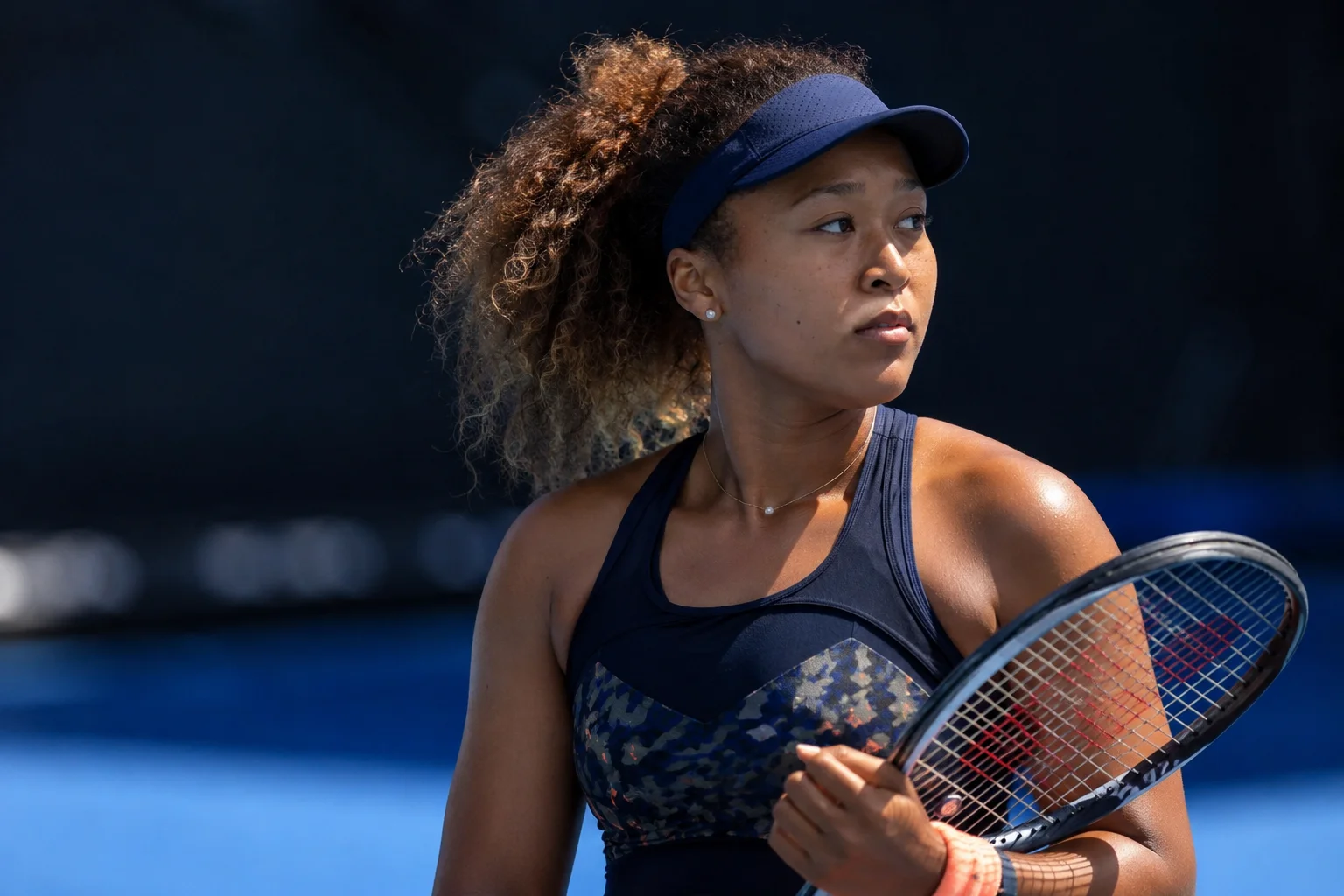
Naomi Osaka
Four-time Grand Slam champion and former World No. 1, Naomi Osaka became the first Japanese player to win a major singles title in 2018 and the first Asian player ever to top the WTA rankings. Now 28, she's rebuilding toward...
Personal Information
Biography
Osaka at 14, No Junior Circuit
Naomi Osaka was born October 16, 1997, in Chuo-ku, Osaka, Japan, and raised in the United States from childhood. Her father, Leonard Francois, from Jacmel, Haiti, taught himself tennis and coached Naomi and sister Mari, modeling his approach on Richard Williams. Her mother, Tamaki Osaka, is from Nemuro, Hokkaido, and both daughters carry her Japanese surname. The family settled in Florida and raised both sisters to represent Japan, a choice they call a reflection of who they are.
Osaka never played the junior circuit and turned professional at 14 in 2012. Her WTA main draw debut came at the 2014 Stanford Classic, where, at 16, she defeated No. 19 Sam Stosur from match point down before losing to Andrea Petkovic. By 2016 she reached her first WTA final, at the Tokyo Pan Pacific Open, losing to Caroline Wozniacki, and was named WTA Newcomer of the Year.
A Tearful First Major
The 2018 US Open final between Naomi Osaka and Serena Williams remains among tennis's most discussed matches. Osaka won it 6-2, 6-4. Umpire Carlos Ramos issued three code violations to Williams: a coaching violation after her coach signaled from the stands, a point penalty for racket abuse, and a game penalty after Williams disputed that call. The crowd booed through the ceremony, and Osaka cried. Williams praised her opponent to the crowd; Osaka apologized for how the match ended. At 20, she became the first Japanese player to win a Grand Slam singles title.
Fourteen months later, at the 2019 Australian Open, she defeated Petra Kvitova in three sets for her second Grand Slam, pushing her to World No. 1 as the first Asian player to hold the ranking.
No. 1, First Asian Player Ever
Naomi Osaka first reached World No. 1 on January 28, 2019, holding it for 25 weeks. That year she won Osaka's Pan Pacific Open and the Beijing China Open, finishing ranked No. 4. In 2020, her impact widened beyond results. At the US Open, played inside a COVID-19 bubble in New York, she wore seven masks across seven rounds, each naming a Black American who had been killed: Breonna Taylor, Elijah McClain, Ahmaud Arbery, Trayvon Martin, George Floyd, Philando Castile, and Tamir Rice. She won the title, defeating Victoria Azarenka 3-6, 6-3, 6-3 for her third Grand Slam. Her endorsement income that year reached roughly 37.4 million dollars, the highest ever recorded for a female athlete and eighth among all athletes worldwide. Sports Illustrated named her a 2020 Sportsperson of the Year.
May 31, 2021: She Stepped Away
Osaka opened 2021 by winning the Australian Open, defeating Jennifer Brady 6-4, 6-3 for her fourth Grand Slam title and a 4-0 record in Grand Slam finals. Before Roland Garros, she announced she would skip mandatory press conferences over their effect on her mental health. After her first-round win on May 30, she followed through, and the four Grand Slams fined her 15,000 dollars, warning of possible disqualification. On May 31, she withdrew, disclosing in her statement that she had been suffering from depression since the 2018 US Open, in her own words. She also withdrew from Wimbledon, wrote a TIME essay on mental health in sport, and appeared on its cover. Laureus named her its 2021 World Sportswoman of the Year.
On July 23, 2021, Osaka lit the Olympic cauldron at the Tokyo Games Opening Ceremony as final torchbearer, the first tennis player given that honor.
Four Slams, Still Only 28
Osaka announced her pregnancy on January 11, 2023; daughter Shai was born that early July. She returned to the WTA Tour in 2024. In 2025, she won the WTA 125 title at Saint Malo, reached finals at Auckland and the WTA 1000 in Montreal, and made the US Open semifinals, her best Grand Slam result in four years and first time back in the Top 20 since January 2022.
In 2026, Naomi Osaka reached the fourth round of the French Open for the first time in her career, playing Roland Garros's first women's night match since 2023, and advanced to the final at Bad Homburg on grass before retiring with a foot injury. Her tennis career stats now read four Grand Slam titles, a 4-0 final record, and 25 weeks at World No. 1 entering Wimbledon on July 1, 2026.
She is 28 years old. The US Open, where she won twice and where her career's most complex chapter began in 2018, is next on the calendar.
FAQs About Naomi Osaka
How old is Naomi Osaka ?
Naomi Osaka was born October 16, 1997, making her 28 years old as of July 2026.
Why is Naomi Osaka trending ?
Osaka is drawing attention during Wimbledon 2026, both for advancing past the first round in a kimono-inspired match outfit that made global fashion headlines and for a strong 2026 season that included her first-ever Roland Garros fourth round.
Is Naomi Osaka married ?
No, Osaka has never been married. She was in a long-term relationship with rapper Cordae, with whom she shares a daughter, but the two confirmed their breakup in January 2025.
How tall is Naomi Osaka ?
Osaka's official WTA player profile lists her height as 5'11" (180 cm).
Where does Naomi Osaka live ?
Osaka has been based in Florida for most of her career, training in the Boca Raton area, though as a touring professional she spends much of the year traveling for tournaments.
Why does Naomi Osaka play for Japan ?
Osaka was born in Japan to a Japanese mother and Haitian father, and her family made an early decision for her and her sister Mari to represent Japan, describing it as a reflection of the Japanese and Haitian household she was raised in rather than a strategic choice.
Can Naomi Osaka speak Japanese ?
Osaka understands Japanese well, having grown up around her mother's side of the family, but she is not fully fluent speaking it and typically responds to Japanese reporters in English.
Who are Naomi Osaka's parents ?
Her father is Leonard Francois, from Jacmel, Haiti, and her mother is Tamaki Osaka, from Nemuro, Hokkaido, Japan.
Are Naomi Osaka parents together ?
Yes, according to multiple published family profiles, Leonard Francois and Tamaki Osaka remain married and continue to support Osaka's career together.
Who is Naomi Osaka's coach ?
Osaka's current coach is Tomasz Wiktorowski, the former lead coach of Iga Świątek, whom she hired in mid-2025 after splitting from Patrick Mouratoglou.
Is Naomi Osaka American or Japanese ?
Osaka was born in Japan and competes internationally for Japan; she announced in 2019 that she would choose Japanese nationality, as required by Japan's dual-citizenship law before age 22.
Is Naomi Osaka autistic ?
There is no official confirmation that Naomi Osaka has an autism diagnosis. She has spoken publicly about being introverted and managing social anxiety, but that is separate from an autism diagnosis, and no such diagnosis has been disclosed by her or confirmed by an official source.
Does Naomi Osaka have US citizenship ?
Osaka held dual US-Japanese citizenship for most of her life but announced in 2019 that she would relinquish it and choose Japanese nationality, in line with Japan's law requiring dual citizens to pick one nationality before turning 22.
How old is Naomi Osaka daughter ?
Osaka's daughter, Shai, was born in early July 2023, making her 2 years old and about to turn 3 as of this writing in July 2026.
What racket does Naomi Osaka use ?
Osaka plays with a Yonex Ezone 98 racket, a partnership with the Japanese equipment brand that dates back to her youth.
What shoes does Naomi Osaka wear ?
Osaka has been a Nike athlete since 2019, wearing Nike's on-court footwear and apparel, including designs that incorporate her personal monogram and Japanese heritage.
How much does Naomi Osaka make ?
Forbes ranked Osaka No. 8 on its 2025 Highest-Paid Female Athletes list, with most of her income coming from endorsements such as Nike and Yonex, alongside more than 24 million dollars in career WTA prize money.
Career Timeline
Turned professional at age 14, skipping the junior circuit entirely to go straight to the pro tour.
As an alternate ranked No. 406, upset No. 19 seed Samantha Stosur at the Stanford Classic, coming back from a match point down.
Reached her first career WTA final at the Pan Pacific Open in Tokyo. Named WTA Newcomer of the Year.
Won her first career title at the BNP Paribas Open, defeating Maria Sharapova, Simona Halep, and Daria Kasatkina without dropping a set.
Defeated Serena Williams 6-2, 6-4 in a final overshadowed by the Carlos Ramos umpiring controversy. Became the first Japanese player to win a Grand Slam singles title.
Won the Australian Open (d. Kvitova) to become the first Asian player ever to reach the WTA's world No. 1 ranking. Held the top spot for 25 weeks total.
Won Osaka (Pan Pacific Open) and Beijing (China Open), including a win over world No. 1 Ashleigh Barty in the Beijing final.
Won the US Open in the COVID-19 bubble, beating Victoria Azarenka after trailing a set and a break. Wore seven masks during the tournament honoring victims of racial violence, drawing global attention to the Black Lives Matter movement.
Named a co-recipient for her on-court success and off-court activism.
Defeated Jennifer Brady in the final, becoming the first woman since Monica Seles to win each of her first four Grand Slam finals.
Withdrew from Roland Garros after being fined for skipping a press conference, disclosing in her withdrawal statement that she had experienced depression since the 2018 US Open. Also withdrew from Wimbledon.
Wrote a TIME magazine essay on athlete mental health and was named Laureus World Sportswoman of the Year.
Became the first tennis player to light the Olympic cauldron, serving as final torchbearer at the Tokyo 2020 Opening Ceremony.
Reached the final — her first since the 2021 Australian Open — losing to Iga Świątek.
Announced her pregnancy in January 2023 and began a maternity break; daughter Shai was born in early July 2023.
Returned to the WTA Tour, reaching the quarterfinals at Doha and 's-Hertogenbosch and Round of 16 at Rome and Beijing.
Reached her first WTA final since returning from maternity leave.
Won the Saint Malo Open, her first title since returning to competition.
Reached the Canadian Open final, her sixth career WTA 1000 final.
Reached the semifinals at Flushing Meadows — her first Grand Slam semifinal since the 2021 Australian Open — losing to Amanda Anisimova. Returned to the Top 20 for the first time since January 2022.
Reached the final on grass, retiring at the start of the second set against Karolina Muchová due to a foot injury — an eighth career WTA finalist appearance.
Advanced to the fourth round at the French Open for the first time in her career, losing to world No. 1 Aryna Sabalenka in the tournament's first women's night match since 2023.
Entered as the No. 14 seed; defeated Elsa Jacquemot in the first round, currently in progress against Anastasia Gasanova in the second round.