Max Verstappen
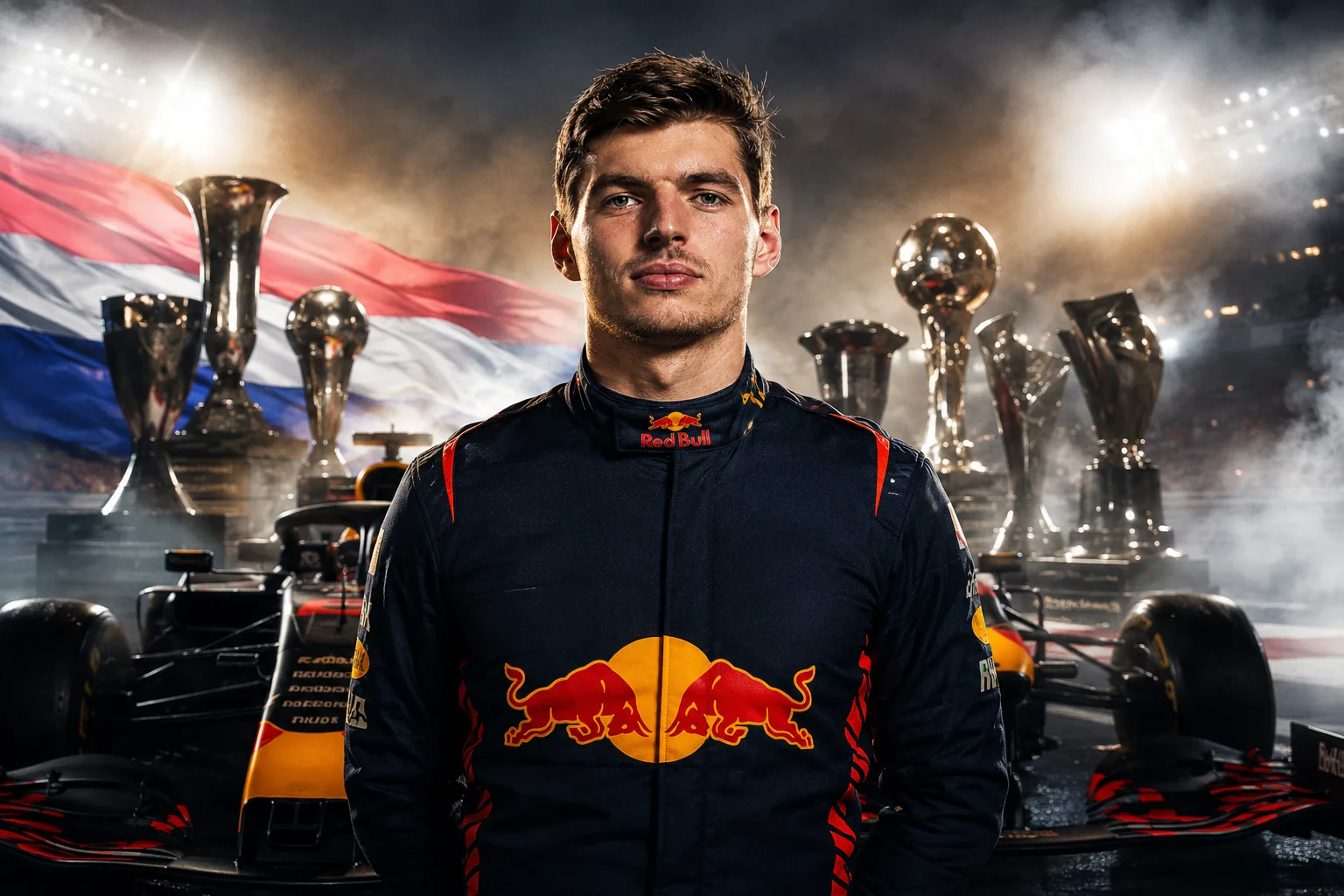
Max Verstappen is a four-time Formula 1 World Champion and one of the greatest drivers in motorsport history. The Dutch racing icon holds the records for most wins in a single season (19 in 2023), most consecutive race wins (10), and the highest win percentage in an F1 season (86.4%). Racing for Red Bull since 2016, he became the youngest driver ever to start and win a Grand Prix, and is widely regarded as a generational talent in a class of his own.
Personal Information
Biography
Early Life: Born Into the Fast Lane
There was never a version of Max Verstappen's life that didn't involve racing. Born on 30 September 1997 in Hasselt, Belgium — just across the Dutch border — he arrived into a family where speed wasn't a hobby, it was a heritage. His father, Jos Verstappen, competed in 107 Formula 1 Grands Prix across a decade-long career. His mother, Sophie Kumpen, was herself a formidable kart racer who competed at the highest levels of the sport across Europe. When family members ask how Max became a world champion, the honest answer is: it was almost inevitable.
Max was riding quad bikes by the age of two. By four, he had graduated to a proper kart. His early childhood was defined not by schoolyard games but by lap times, throttle control, and the unforgiving logic of competitive racing. Jos — who split from Sophie when Max was young — took an active, sometimes controversial role in pushing his son toward elite performance. Training sessions were intense, expectations were clear, and for better or worse, the mental resilience that would one day carry Verstappen through championship deciders was forged in those formative years.
Max has a younger sister, Victoria, who has since become a social media personality. He also holds close bonds with Kelly Piquet's daughter Penelope from a previous relationship — a family unit he speaks about with quiet warmth whenever asked. Max and Kelly welcomed their first daughter together, Lily Verstappen, in May 2025, shortly before the Miami Grand Prix.
The young Verstappen grew up speaking Dutch and was educated in Belgium before his family's lifestyle increasingly revolved around European racing circuits. He is fluent in Dutch, English, German, and French — a linguistic dexterity that would later make him one of the sport's most eloquent and direct communicators with the global media.
Karting Career: The Making of a Champion
Max's karting career was not a gradual rise — it was an accelerated demolition of expectations. By age seven, he had won his first competitive race. By 11, he was competing across European championships. The trajectory was steep from the start.
Between 2010 and 2013, Verstappen dominated the karting scene at multiple levels. He competed across KF, KF2, and KZ categories, claiming titles at regional, national, and European level. In 2013 — his final year in karting — he won the CIK-FIA KF European Championship and the CIK-FIA KF World Championship, cementing his status as the most promising junior talent in the sport.
His kart performances drew serious attention from Formula 1 teams even before he was old enough to hold a road driving license. Both Mercedes and Red Bull came calling, and the decision he and his father made would change the trajectory of the sport entirely.
Junior Career: The Fastest Path to the Top
Verstappen skipped Formula 2 entirely — an extraordinary move that reflected both the raw pace he possessed and the urgency with which Red Bull's junior program wanted to harness it.
In 2014, Max entered the FIA Formula 3 European Championship driving for Van Amersfoort Racing. At just 16 years old — driving in a championship where most competitors were two or three years older — he finished third in the standings overall, claiming ten podiums in his debut season. It was an exceptional performance that made immediate promotion viable.
That same year, he won the prestigious Masters of Formula 3 in Zandvoort — a one-off invitational race that has historically served as a barometer for the very best junior talent. His season total caught the eye of every major F1 team, and Red Bull moved quickly to secure him for Toro Rosso, their junior outfit, for the 2015 season.
He was, at the time of his F1 contract signing, still too young to legally drive a car on public roads.
Formula 1 Debut: The Youngest Driver in History (2015)
When Max Verstappen lined up for the 2015 Australian Grand Prix with Toro Rosso, he was 17 years and 166 days old — the youngest driver ever to start a Formula 1 World Championship race. The record stood as a monument to the audacity of the move.
His first season was not without growing pains. The Toro Rosso–Ferrari package was midfield at best, and Verstappen occasionally showed the impulsiveness of a teenager still learning his craft at 300 km/h. But the potential was unmistakable. There were wheel-to-wheel battles that left hardened veterans shaking their heads in disbelief. There were qualifying performances that put far more experienced drivers to shame.
He finished twelfth in the championship, scored 49 points, and was voted Rookie of the Year by a paddock that had already begun to whisper about something different, something generational.
Red Bull Debut: Youngest Race Winner in History (2016)
The call came four races into the 2016 season. Daniil Kvyat was moved back to Toro Rosso. Max Verstappen, age 18, was promoted to Oracle Red Bull Racing.
His debut race in Red Bull colours was the 2016 Spanish Grand Prix in Barcelona — and what followed has been replayed thousands of times. Starting fourth on the grid, managing a chaotic opening lap, finding himself in position as the leaders clashed and retired, Verstappen made moves that no 18-year-old should have been able to execute under that pressure. He crossed the line first.
At 18 years and 228 days old, Max Verstappen became the youngest Grand Prix winner in Formula 1 history. The record, like his youngest starter record, remains his today.
The rest of 2016 confirmed what that day in Barcelona suggested. Seven podiums. Fifth in the championship. A driving style that combined raw speed with remarkable spatial awareness in close combat — something that felt less like a skill being developed and more like a natural language he simply spoke.
Building the Foundation: 2017–2020
The years between 2017 and 2020 were Verstappen's technical education at the front of Formula 1. Red Bull's car was rarely the outright fastest, which meant every result required something extra from the driver's seat.
2017: Two victories — Malaysia and Mexico — amid a season blighted by reliability issues. Three DNFs from mechanical failures. Yet even in adversity, Verstappen showed a capacity for recovery drives that became a calling card.
2018: Two more wins in Austria and Mexico. A season that saw him overtake Daniel Ricciardo decisively as the team's lead driver and primary development reference. The internal dynamic at Red Bull shifted permanently.
2019: The Honda era began. Three victories. Two poles. Third in the championship. The Austrian Grand Prix win — at Red Bull's home race — was delivered with such authority that it prompted fresh speculation about a championship challenge when the regulations allowed.
2020: A shortened season by Covid standards. Two wins. Eleven podiums in seventeen races. Third in the championship behind Hamilton and Bottas. The building blocks were in place.
What these years produced was a driver who had been tested without the comfort of the best car. Every win was earned against adversity. Every championship point required more than pace — it required precision, tire management, strategy, and mental resilience. By the time 2021 arrived, Verstappen was not just fast. He was complete.
2021: The Championship That Changed Everything
The 2021 Formula 1 World Championship is one of the most debated sporting contests in the history of motorsport. It ran across 22 races, came down to the final lap of the final race, and produced a conclusion so controversial that it permanently altered the FIA's stewarding procedures.
From the opening round in Bahrain, it was clear this would be different. Mercedes had Hamilton. Red Bull had Verstappen. For the first time in years, the machinery was close enough that the drivers would genuinely decide it.
Verstappen won ten Grands Prix across the season. Hamilton won eight. They traded the championship lead across multiple rounds. At Silverstone they collided, with Hamilton winning despite a fifty-second penalty and Verstappen spending time in a hospital being assessed for concussion. The narrative became as much about their personalities as their lap times — Verstappen blunt and unapologetic; Hamilton eloquent and historically conscious.
The climax came in Abu Dhabi. Heading into the final lap, Hamilton led. A late safety car period, a highly controversial decision by Race Director Michael Masi to allow only the lapped cars between Hamilton and Verstappen to unlap themselves, and a set of fresh tyres put Verstappen in position to overtake on the final lap.
He did. He became Formula 1 World Champion. He became the Netherlands' first-ever Formula 1 World Champion.
The result was immediately disputed by Mercedes, who lodged two protests. Both were rejected. The stewards' decision stood. Hamilton, gracious in defeat, did not appear at the post-race press conference. Verstappen's father Jos broke down in tears.
Max himself, when asked how he felt, said simply: "I hate losing. So it feels good to win."
2022: Total Domination, Era Confirmed
If 2021 was dramatic, 2022 was definitive. Red Bull's RB18 was the fastest car in the field, and Verstappen exploited it with ruthless efficiency.
He won 15 of 22 races — at the time the most victories in a single Formula 1 season. He scored 454 championship points, also a seasonal record. He clinched the title at the Japanese Grand Prix with four races still remaining.
The doubters who had attributed 2021 to a controversial finish were silenced. This was not an asterisk champion. This was a driver of historic proportions operating at historic levels.
Charles Leclerc challenged in the early rounds as Ferrari got off to a strong start. But reliability issues at Maranello, combined with Verstappen's clinical consistency, ultimately produced a championship that was less a contest than a demonstration.
2023: The Most Dominant Season in Formula 1 History
The numbers from Max Verstappen's 2023 Formula 1 season are so extreme they almost resist comprehension.
19 wins from 22 races. A record so far beyond anything previously achieved that it may stand for decades.
575 championship points. The highest single-season total in the sport's history, breaking the record he had set the previous year.
10 consecutive victories. Surpassing Sebastian Vettel's previous record of nine straight wins.
86.4% win rate across a season. In the history of the sport, no figure comes close.
21 podiums from 22 races. The only race he failed to podium was Singapore, where he finished fifth after a difficult weekend.
1,003 laps led — the first time any driver had led over 1,000 laps in a single season.
The only race result that interrupted the run was Singapore. Everywhere else — Bahrain, Jeddah, Melbourne, Miami, Monaco, Barcelona, Montreal, Silverstone, Budapest, Spa, Zandvoort, Monza, Suzuka, Lusail, Austin, Mexico City, São Paulo, Las Vegas, Abu Dhabi — it was Verstappen, first, on the top step of the podium.
His third consecutive championship was secured at the Qatar Grand Prix in October 2023. The celebrations in the motorhome that evening were reportedly more muted than the occasions that preceded them. Those closest to Verstappen understood why — a driver who defines himself by hatred of losing finds less joy in inevitable victory than he does in hard-won battles.
2024: The Fourth Title, Against the Tide
The 2024 season was markedly different in narrative texture. McLaren and Ferrari both produced competitive machinery. Red Bull's RB20, dominant in the first half of the year, faded significantly as the championship progressed.
Verstappen won nine races — still a figure most champions would consider a career highlight. But as the season entered its final third, McLaren's Lando Norris and Ferrari's Charles Leclerc began mounting genuine challenges. The championship battle tightened in a way 2022 and 2023 had not.
In Las Vegas — a race held under circumstances that had earlier in the season included Verstappen receiving a ten-second penalty in Mexico City — he finished fifth. Norris finished sixth. The 63-point gap with 60 points remaining meant the arithmetic was conclusive before the final two races.
Four consecutive championships. One of only five drivers in the sport's history to achieve that distinction — alongside Fangio, Schumacher, Vettel, and now Verstappen. A marker of sustained excellence that places him firmly in the conversation about the greatest drivers of all time.
2025: The Season That Almost Made It Five
The 2025 Formula 1 season — the final year of current technical regulations — produced arguably the most competitive championship fight since 2021. McLaren, with Lando Norris as their primary weapon, pushed Red Bull to the limit from the opening round.
Verstappen fought back from numerous difficult positions throughout the season. Red Bull's reliability issues, combined with McLaren's pace advantage at certain circuit types, meant the championship went to the final race at Abu Dhabi. Norris ultimately won the championship by two points — the narrowest possible margin.
Verstappen finished second with 421 points. He won multiple Grands Prix during the campaign, including a final victory at Abu Dhabi — his last win to date as of May 2026. He drove the 2025 season as well as any championship year of his career, and the conclusion illustrated that even the greatest drivers can lose to circumstances as much as competitors.
He also became a father. Daughter Lily was born in May 2025. Those who know him well say the experience has quietly shifted aspects of his perspective — though never, apparently, his hatred of losing.
2026: A New Regulation Era, New Challenges
Formula 1's 2026 regulations introduced radically different technical rules — new power units with a 50/50 split between internal combustion and electrical energy, new aerodynamic concepts, and a grid reset that was always likely to shuffle the competitive order.
For Red Bull, 2026 has been particularly challenging. Having produced their own power unit for the first time — in partnership with Ford — the team arrived at the Australian Grand Prix with genuine uncertainty about their relative pace. Early signs in Bahrain testing were cautiously optimistic. But the reality of the competitive session in Melbourne was stark: Red Bull were adrift of Mercedes and Ferrari.
Verstappen crashed in Q1 in Australia — an uncharacteristic error — but recovered to finish sixth from twentieth on the grid. In China, the situation worsened. The RB22 showed fundamental issues with graining and energy management, and Verstappen was blunt in his assessment: "Just a lot of graining, can't push, terrible pace, terrible balance."
As of late May 2026, Verstappen sits seventh in the drivers' championship with 43 points from five races. The best result has been a third place in Canada — his sole podium of the season. Rumors of exit clauses, Mercedes conversations, and potential sabbaticals have circulated with increasing frequency in the paddock.
Verstappen himself has been characteristically direct: he has expressed frustration with the car, concern about the direction, and — for the first time in his career — a hint that the relentless grind of F1's new era may not be what it once was. Whether 2026 represents a temporary dip before Red Bull and Ford find their footing, or the beginning of a new chapter in Verstappen's story, remains one of the most compelling storylines in the sport.
Driving Style: The Art of Maximum Attack
Max Verstappen drives as though the concept of a comfort zone does not apply to him. His approach is defined by several interconnected qualities that, taken together, produce something rare in the modern era of Formula 1.
Wet-weather mastery. His drive at the 2016 Brazilian Grand Prix — attacking on an soaked circuit, overtaking multiple cars in conditions that forced rivals to dial back — remains one of the finest displays of raw wet-weather ability the sport has seen. Ask any driver who competed that day and they will confirm they were watching something different.
Tyre management under pressure. Contrary to the early perception of him as a pure attack driver, Verstappen's understanding of tyre degradation developed significantly from 2019 onward. He can manage tyres when races demand it and attack when they allow — a flexibility that requires sophisticated technical understanding as well as instinct.
Spatial awareness. His ability to simultaneously carry corner speed and control the space around his car — particularly in wheel-to-wheel combat — borders on the supernatural. Rivals have consistently noted that trying to overtake him requires accepting risk, because he leaves no margin.
Rain driving. He is widely regarded as the best wet-weather driver of his generation, and arguably in the top five in the sport's history.
Starting ability. His race starts — particularly at high-pressure championship deciders — have been consistently among the best on the grid.
What has changed since his early career is the discipline. The Verstappen of 2016–2018 occasionally overextended his aggression. The Verstappen of 2021–2025 channels that same instinct through a filter of strategic intelligence that makes it exponentially more effective.
Records and Milestones: Rewriting History
| Record | Detail |
|---|---|
| Most wins in a single F1 season | 19 wins (2023) |
| Most consecutive F1 race wins | 10 wins (2023) |
| Most championship points in a single season | 575 points (2023) |
| Highest win percentage in a season | 86.4% (19 of 22 races, 2023) |
| Most laps led in a single season | 1,003 laps (2023) |
| Highest percentage of laps led in a season | 75.7% (2023) |
| Youngest F1 race winner | 18 years, 228 days (2016 Spanish GP) |
| Youngest F1 race starter | 17 years, 166 days (2015 Australian GP) |
| Youngest driver to achieve a Grand Slam | 23 years, 277 days (2021 Austrian GP) |
| Most consecutive pole positions | 8 (shared record, Nov 2023 – May 2024) |
| Most hat tricks (pole+win+fastest lap) in a season | 6 (2023) |
| Netherlands' first F1 World Champion | 2021 |
| Most consecutive F1 titles | 4 (2021–2024) |
| Most wins for Red Bull Racing | 71+ |
Personal Life: Beyond the Cockpit
Max Verstappen lives in Monaco — a tax-efficient residence that many top-tier F1 drivers call home, though Verstappen has been transparent that his Dutch identity remains central to who he is. He returns regularly to the Netherlands, where his fanbase — the "Orange Army" — is arguably the most visible and passionate national contingent in motorsport.
He has been in a relationship with Kelly Piquet since 2020. Kelly is the daughter of Nelson Piquet — himself a three-time Formula 1 World Champion — and previously had a daughter, Penelope, with Russian F1 driver Daniil Kvyat. Max has embraced Penelope as part of the family. In May 2025, Kelly and Max welcomed their first child together, a daughter named Lily Verstappen.
Outside of racing, Verstappen is a passionate sim racer who competes regularly on iRacing and other platforms. He has spoken candidly about how sim racing relaxes him, keeps his reflexes sharp, and provides a form of competition that doesn't require travelling to a circuit. He founded Verstappen.com Racing in 2022 — now known simply as Verstappen Racing — which competes in rallying, GT racing, and endurance events. In 2026, he participated in the Nürburgring 24 Hours as part of a four-driver lineup in a Red Bull-liveried Mercedes-AMG GT3.
His car collection is extensive and reflects genuine enthusiasm rather than mere status acquisition: an Aston Martin Valkyrie, Ferrari SF90, Honda NSX Type S, Renault R.S.01, Aston Martin Vantage, and Porsche 911 GT3 RS among others.
He is also notably involved in charitable work — donating $250,000 following a race bet in 2024, contributing to Australian bushfire relief and Brazilian flood relief efforts. Away from the track, those who work with him consistently describe a quieter, more considerate personality than the fierce competitor suggests.
Max Verstappen Wife
Although many fans search for "Max Verstappen wife," the four-time Formula 1 World Champion is not currently married. Verstappen has been in a long-term relationship with Kelly Piquet since 2020.
Kelly Piquet is the daughter of three-time Formula 1 World Champion Nelson Piquet and has become one of the most recognizable figures in the Formula 1 paddock. The couple frequently appear together at Grand Prix weekends, charity events, and public engagements.
In May 2025, Verstappen and Kelly welcomed their first child together, daughter Lily Verstappen. He also shares a close bond with Kelly's daughter Penelope from her previous relationship with former Formula 1 driver Daniil Kvyat.
While marriage rumors regularly circulate online, neither Verstappen nor Kelly Piquet has publicly announced wedding plans as of 2026. Despite the continued interest around "Max Verstappen wife," Kelly remains his long-term partner rather than his wife.
Max Verstappen Merch and Official Products
Max Verstappen merchandise is among the best-selling driver merchandise in Formula 1. His global fan base, often known as the "Orange Army," purchases millions of dollars worth of apparel and collectibles every year.
Popular Max Verstappen merch includes:
- Official Red Bull Racing team jerseys
- Driver caps and snapback hats
- Race-day T-shirts
- Limited-edition championship collections
- Scale model Formula 1 cars
- Hoodies and jackets
- Signed memorabilia and collectibles
- Verstappen Racing branded products
Many special-edition collections are released throughout the season, particularly after championship victories and major milestones. Limited championship merchandise from his title-winning seasons in 2021, 2022, 2023, and 2024 became some of the highest-selling Formula 1 products worldwide.
Fans looking for official Max Verstappen merch can purchase products through the dedicated Verstappen store, Red Bull Racing's official merchandise channels, and selected Formula 1 retail partners. Demand for Verstappen merchandise remains among the highest of any active Formula 1 driver, reflecting his status as one of the sport's most popular athletes.
Sponsorships and Brand Partnerships
Verstappen's commercial profile has grown significantly alongside his championship success. His endorsement portfolio as of 2026 includes:
- Oracle (Red Bull Racing title sponsor, integral to his team identity)
- TAG Heuer (watch ambassador — a longstanding partnership)
- Jumbo (Dutch supermarket chain — his most visible domestic brand)
- EA Sports (video game ambassador — reflects his genuine sim racing passion)
- Bybit (cryptocurrency exchange — Red Bull partnership)
- Heineken (F1's primary beer partner)
- G-Star Raw (clothing brand)
- Exact (Dutch software company)
His endorsement income is estimated at $15–25 million annually on top of his racing salary.
Max Verstappen Net Worth
Max Verstappen is the highest-paid Formula 1 driver on the current grid. His Red Bull contract, signed in 2022 and running through 2028, is worth an estimated $65–70 million per year in base salary, with performance bonuses that can push total annual compensation significantly higher.
- Estimated total compensation 2024: $76 million (Forbes)
- Estimated total compensation 2025: $72 million (Forbes)
- Estimated net worth (2026): $200–250 million
- Career F1 earnings: $245+ million
His per-race earnings at base salary equate to approximately $3.5 million per Grand Prix weekend — before bonuses for race wins and championship points are factored in.
He ranked 17th on the Forbes 2025 list of the world's highest-paid athletes.
FAQs
How old is Max Verstappen ?
Max Verstappen was born on 30 September 1997 in Hasselt, Belgium. He is 28 years old as of 2026. He has been competing in Formula 1 since 2015 and became the sport's youngest starter at just 17 years old.
How many championships does Max Verstappen have ?
Max Verstappen has won four Formula 1 World Drivers' Championships — in 2021, 2022, 2023, and 2024, all consecutive. He is one of only five drivers in F1 history to win four or more consecutive titles, alongside Juan Manuel Fangio, Michael Schumacher, Sebastian Vettel, and himself. He narrowly missed a fifth consecutive title in 2025, finishing runner-up to Lando Norris by just two points.
Can Max Verstappen still win the championship ?
As of May 2026, Verstappen sits seventh in the Formula 1 drivers' championship with 43 points from five races. Red Bull's RB22 has been significantly uncompetitive in the early rounds of the new regulation era. While a 2026 title cannot be ruled out — Verstappen has shown remarkable comeback ability throughout his career — the current deficit to the championship leaders is substantial. The picture could change significantly if Red Bull develop their car through the season.
Where is max verstappen from ?
Max Verstappen was born in Hasselt, Belgium, but he holds Dutch nationality. Born to a Dutch father and a Belgian mother, he grew up primarily in the Netherlands and competes in Formula 1 under the Dutch flag using a Dutch racing license.
How much does Max Verstappen make a year ?
Max Verstappen earns an estimated $65–70 million per year in base salary from Red Bull Racing under his current contract, which runs through 2028. Including performance bonuses for race wins and championship points, his total on-track annual compensation can exceed $80 million. He also earns an estimated $15–25 million annually from endorsement deals with brands including TAG Heuer, Jumbo, EA Sports, and others. His total estimated net worth as of 2026 is between $200 million and $250 million.
Why is Max Verstappen trending right now ?
Max Verstappen is regularly trending in 2026 due to the combination of Red Bull's unexpected performance struggles in the new regulation era, growing speculation about his future beyond 2026, and his prominence as one of the sport's biggest names. Reports in May 2026 suggested his camp has had conversations with Mercedes, fuelling further speculation about whether he will see out his Red Bull contract to 2028 or explore other options. His uncharacteristic mid-grid position in the current standings makes every race weekend a major news story.
Is Max Verstappen Dutch ?
Max Verstappen competes under the Dutch flag and holds Dutch citizenship through his father Jos, who is Dutch. However, he was born in Hasselt, Belgium, and also has Belgian heritage through his mother Sophie Kumpen. He grew up speaking Dutch, holds strong connections to the Netherlands, and is the country's first-ever Formula 1 World Champion. He resides in Monaco.
Is Max Verstappen the best F1 driver ever ?
This is one of the most debated questions in modern sport. Verstappen's case is built on extraordinary statistical dominance — the 2023 season in particular produced numbers that no driver in the sport's history has come close to matching. His four consecutive championships, 71 career wins, and multiple all-time season records give him a statistical profile that is unrivalled in certain metrics. The counterarguments typically centre on career longevity (Hamilton has 105 wins and 7 titles), historical context (Fangio, Senna, Schumacher operated in different eras), and the relative quality of machinery. At 28, Verstappen has the opportunity to build a case that answers this question definitively.
How many Grand Prix wins does Max Verstappen have ?
Max Verstappen has 71 Formula 1 Grand Prix victories as of May 2026. He won 19 races in 2023 alone — the most wins any driver has recorded in a single F1 season. His last victory was at the 2025 Abu Dhabi Grand Prix.
What car does Max Verstappen drive daily in iracing ?
Max Verstappen doesn't drive just one car in iRacing; he is a versatile sim racer who drives a wide variety of vehicles, though he is most frequently seen driving GT3 cars and Formula 1 cars.
What languages does Max Verstappen speak ?
Max Verstappen is fluent in four languages: Dutch, English, German, and French. He speaks all four with notable fluency, regularly conducting post-race interviews in multiple languages and switching between them depending on the interviewer or broadcast.
Does Max Verstappen have a child ?
Yes. Max Verstappen and his partner Kelly Piquet — daughter of three-time F1 champion Nelson Piquet — welcomed their first daughter, Lily Verstappen, in May 2025, shortly before the Miami Grand Prix. Verstappen also has a close relationship with Kelly's daughter Penelope from her previous relationship with F1 driver Daniil Kvyat.
What happened at the 2021 Abu Dhabi Grand Prix ?
The 2021 Abu Dhabi Grand Prix is the most controversial race finish in recent F1 history. Verstappen and Hamilton arrived at the final race tied — or effectively tied — in the championship standings. Hamilton was leading with one lap remaining when a late safety car period caused by Nicholas Latifi's crash triggered a contentious stewarding decision. Race Director Michael Masi allowed only the lapped cars between the two title contenders to unlap themselves, giving Verstappen fresh tyres and a direct opportunity to attack. He overtook Hamilton on the final lap and won the race and the championship. Mercedes lodged two protests, both of which were rejected. The incident led to significant rule changes in how safety car periods are managed in subsequent seasons.
Is Max Verstappen going to Mercedes ?
As of May 2026, Verstappen remains under contract with Red Bull Racing until 2028. However, reports indicate his camp has held conversations with Mercedes, and speculation about his future has intensified given Red Bull's 2026 performance struggles. Exit clauses in his contract have been previously discussed, and some paddock insiders believe he could be out of Red Bull before 2028. No confirmed move has been announced. Mercedes' current driver lineup — George Russell and Kimi Antonelli — presents its own obstacles to any potential switch before 2027 at the earliest.
Is Max Verstappen the goal of F1 ?
Verstappen is widely regarded by the current generation of Formula 1 drivers as the benchmark — the driver you are measured against. Lando Norris, Charles Leclerc, and others have spoken openly about the standard he sets. Whether he represents the sport's ultimate goal is a matter of personal perspective, but his statistical achievements during his dominant years are, objectively, the highest standards Formula 1 has seen in any measurable era.
What is Max Verstappen's exit clause ?
Reports have indicated that Verstappen's Red Bull contract — signed in 2022 and running through 2028 — contains performance-based exit clauses. One such clause was reported to be activatable if Verstappen fell below fourth place in the drivers' standings at a specified point in the 2025 season. He remained third at the relevant assessment point, making the clause inactive. In 2026, with his championship position significantly lower, the terms of any remaining exit provisions are a matter of considerable speculation among F1 journalists and insiders.
Was Max Verstappen born rich ?
Verstappen came from a motorsport family rather than a traditionally wealthy one. His father Jos Verstappen was an F1 driver, which provided motorsport connections and technical knowledge, but the family's resources were primarily directed toward funding Max's karting career. Multiple reports have noted that Jos Verstappen made significant personal and financial sacrifices — sometimes under difficult personal circumstances — to ensure Max could pursue racing at the highest level. His current wealth of $200–250 million is the product of his own record-breaking F1 career, not inherited privilege.
How many siblings does Max Verstappen have ?
Max Verstappen has one younger sister, Victoria Verstappen, from his parents Jos and Sophie. He also has a close family relationship with Kelly Piquet's daughter Penelope and his own daughter Lily.
What does Max Verstappen do when he's not racing ?
Sim racing is the honest answer. He has said publicly that it is where he goes to be himself, without the weight of the world championship around his shoulders.
Career Timeline
Begins competitive karting at the age of four, under the guidance of his father Jos
Wins the CIK-FIA KF European Championship and CIK-FIA KF World Championship in his final karting season
Joins Van Amersfoort Racing in the FIA F3 European Championship, finishes third overall as a 16-year-old rookie. Wins the Masters of F3
Makes his Formula 1 debut with Toro Rosso at the Australian Grand Prix, aged 17 years and 166 days — the youngest starter in F1 history
Promoted to Red Bull Racing after four races; wins the Spanish Grand Prix on debut aged 18 years and 228 days — the youngest race winner ever
Red Bull switch to Honda power; Verstappen claims three victories and finishes third in championship
Defeats Lewis Hamilton in the most controversial championship finale in decades at Abu Dhabi; becomes the Netherlands' first-ever F1 World Champion
Wins 15 of 22 races; breaks the seasonal wins record; clinches title four rounds early in Japan with 454 points
Wins 19 of 22 races; records 10 consecutive victories; scores 575 championship points; sets multiple all-time F1 records
Wins 9 races; clinches fourth consecutive title in Las Vegas despite Red Bull's mid-season performance decline
Finishes runner-up to Lando Norris by 2 points in the closest championship of the new era; daughter Lily born in May
Enters the new regulation era with Red Bull's first in-house power unit; faces uncharacteristic mid-grid struggles early in the season