Dale Earnhardt
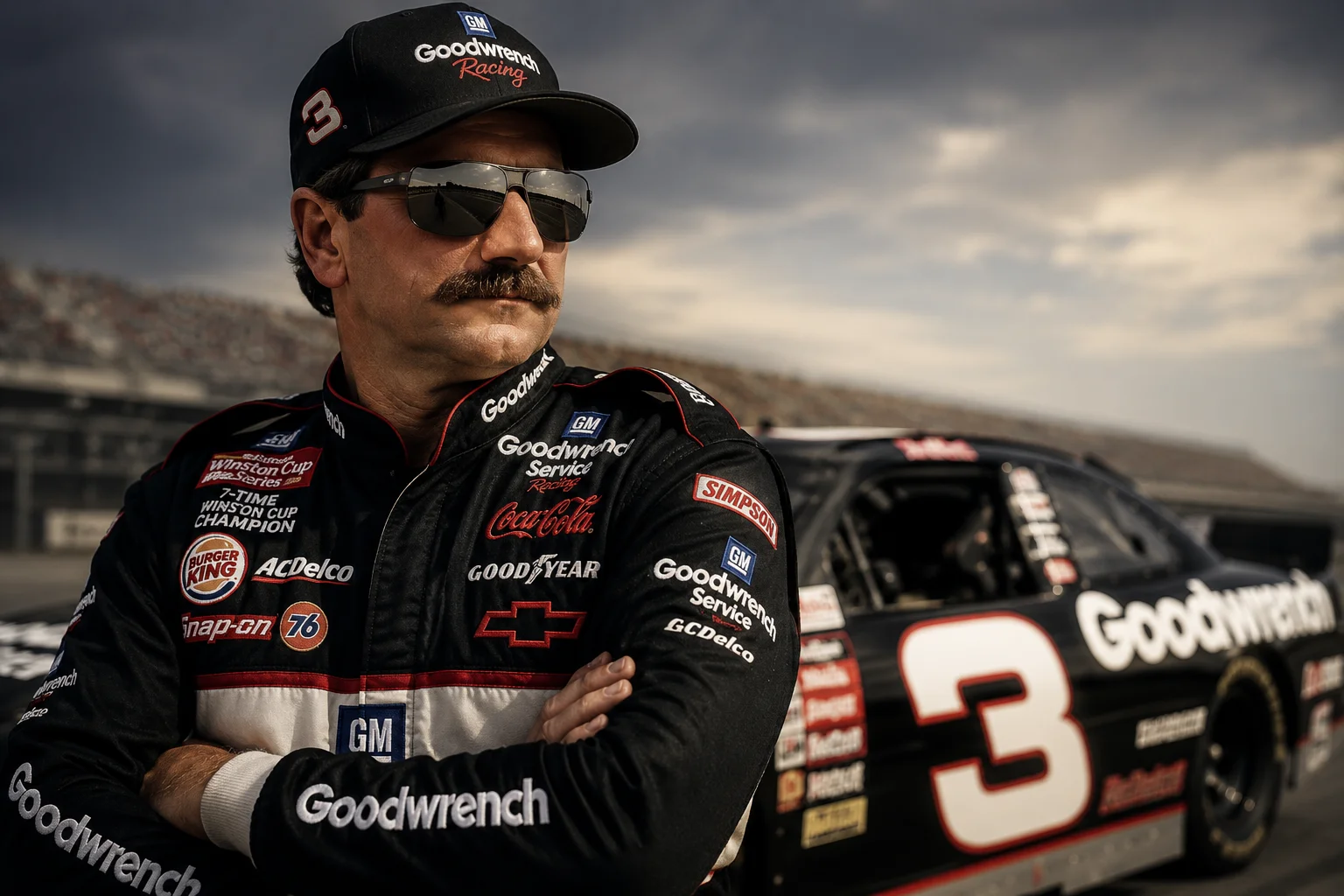
Dale Earnhardt, "The Intimidator," was a seven-time NASCAR Winston Cup champion whose aggressive driving and 76 career wins made him one of motorsports' most dominant and beloved figures.
Personal Information
Biography
Early Life and Racing Roots
—————————————
Ralph Dale Earnhardt was born on April 29, 1951, in Kannapolis, North Carolina, the third child of Ralph and Martha Earnhardt in a working-class mill town roughly thirty miles from Charlotte. Racing was not a hobby he discovered but an inheritance. His father, Ralph Earnhardt, was one of the finest short-track drivers in the Carolinas, a Sportsman Division champion who built his own cars in the family garage and hauled them to dirt tracks across the region. Dale grew up in that garage, absorbing the mechanical instincts and competitive hunger that would define him. He dropped out of school in the ninth grade, convinced that his future belonged behind a wheel rather than a desk. Ralph's sudden death from a heart attack in 1973 left Dale without his mentor, but it also hardened his resolve to carry the family name into NASCAR's top ranks, even as he borrowed money and repaired his own cars to keep racing on local tracks.
Rise Through NASCAR's Ranks
—————————————
Earnhardt made his NASCAR Cup Series debut at the 1975 World 600 in Charlotte, finishing 22nd in a car he could barely afford to run. For several years he raced sporadically, without a full-time ride, until car owner Rod Osterlund gave him a permanent seat in 1979. The opportunity paid off immediately. Earnhardt won at Bristol in just his sixteenth start, piled up seventeen top-ten finishes, and captured the Rookie of the Year title. A year later, in 1980, he won five races and the Winston Cup championship, becoming the first driver in NASCAR history to claim Rookie of the Year and a series title in back-to-back seasons. It was an early signal that Dale Earnhardt's NASCAR career would not follow a conventional arc.
The Intimidator Era
—————————————
Through the 1980s and into the 1990s, Earnhardt became the sport's most feared competitor, a driver who treated the racetrack as contested ground and rarely yielded it. His aggressive, bumper-to-bumper style earned him the nickname "The Intimidator," a reputation cemented by moments like the 1987 All-Star Race "Pass in the Grass," when he kept control of his car after being forced onto the infield turf and still crossed the line first. When Wrangler ended its sponsorship and GM Goodwrench took over, his car turned black, and the image of the No. 3 Chevrolet became inseparable from his persona as "The Man in Black." Racing for Richard Childress Racing through most of this stretch, Earnhardt won six of his seven Winston Cup titles between 1986 and 1994, tying Richard Petty's record and setting the standard the sport measured greatness against.
The 1998 Daytona 500 and Signature Wins
—————————————
For all his dominance, one race eluded him for nearly two decades. Earnhardt entered the Daytona 500 year after year as a favorite, only to lose it in agonizing fashion to late cautions, mechanical failures, and hard luck. That changed on February 15, 1998, when he finally claimed the Daytona 500 in his twentieth attempt, a win met with an emotional pit-road celebration as rival crews lined up to shake his hand. Earnhardt's résumé extended well beyond that single triumph. He won the Southern 500 three times, the Coca-Cola 600 three times, the Brickyard 400 in 1995, and finished his Cup Series career with 76 victories, 281 top-five finishes, and more than $41 million in earnings across 676 starts, numbers that placed him among the sport's statistical elite.
Final Race and Enduring Legacy
—————————————
On February 18, 2001, Earnhardt was competing in the Daytona 500 as both a driver and a team owner, watching his son and his Dale Earnhardt Inc. cars run near the front of the field. On the final lap, he was involved in a crash entering turn three that ended his life; he was pronounced dead a short time later at Halifax Medical Center, with the official cause determined to be a basilar skull fracture. The loss reverberated far beyond the sport's inner circle, prompting NASCAR to accelerate safety reforms that included mandatory head and neck restraint systems and the development of energy-absorbing SAFER barriers now standard at tracks nationwide. In 2010, Earnhardt was inducted into the inaugural class of the NASCAR Hall of Fame, a fitting recognition for a driver whose seven championships, relentless intensity, and hard-won Daytona 500 victory shaped a generation of stock car racing. More than two decades after his death, Dale Earnhardt's championships and his black No. 3 Chevrolet remain touchstones of NASCAR's modern identity, and his influence carries forward through the careers of his children, including NASCAR Hall of Famer Dale Earnhardt Jr.
FAQs About Dale Earnhardt
Dale Earnhardt died on February 18, 2001, following a last-lap crash in the Daytona 500 at Daytona International Speedway. He was pronounced dead a short time later at Halifax Medical Center in Daytona Beach, Florida.
Earnhardt died from a basilar skull fracture sustained in a last-lap crash during the 2001 Daytona 500. His car made contact with Sterling Marlin and Ken Schrader before hitting the outside wall.
Dale Earnhardt died in 2001, on February 18, during the final lap of that year's Daytona 500.
Earnhardt was 49 years old at the time of his death on February 18, 2001. He was born on April 29, 1951, in Kannapolis, North Carolina.
Dale Earnhardt Jr. is alive and remains active in NASCAR as a broadcaster and team owner, so no official information exists confirming any such event. This question likely refers to his father, Dale Earnhardt Sr., who died from a basilar skull fracture in the 2001 Daytona 500.
Earnhardt won seven NASCAR Winston Cup Series championships, in 1980, 1986, 1987, 1990, 1991, 1993, and 1994. That total ties him with Richard Petty and Jimmie Johnson for the most in series history.
Earnhardt was laid to rest in a private family ceremony in February 2001, but his exact gravesite has never been officially disclosed. Reports indicate it sits on private Earnhardt family property in the Mooresville, North Carolina area and is not open to the public.
No single official statement from Bubba Wallace specifically addressing Dale Earnhardt Sr. could be verified through reliable sources. Wallace has referenced the Earnhardt racing legacy respectfully in various NASCAR media interviews, but no confirmed direct quote about Dale Earnhardt Sr. is available.
Dale Earnhardt Sr. did not race with KFC sponsorship. It was his son, Dale Earnhardt Jr., who drove a KFC-sponsored car for Chance 2 Motorsports in select NASCAR Busch Series races in 2004.
Dale Earnhardt Jr. announced his retirement from full-time NASCAR Cup Series racing in April 2017, running his final full-time race that November at Homestead-Miami Speedway. He has made only occasional one-off starts since then.
No officially confirmed report verifies whether Dale Earnhardt Jr. attended Taylor Earnhardt's 2012 wedding to Brandon Putnam. Online claims on this topic are inconsistent and unverified, so no confirmed answer exists.
Dale Earnhardt Jr. lives on a large private estate known as "Dirty Mo Acres" in Mooresville, North Carolina. The exact address is not publicly disclosed for privacy reasons.
Dale Earnhardt is best known for driving the No. 3 Chevrolet for most of his Winston Cup Series career with Richard Childress Racing. Earlier in his career he also drove other numbers, including the No. 2 for Rod Osterlund.
Career Timeline
Earnhardt made his Cup Series debut at the World 600 in Charlotte, finishing 22nd in a self-funded car.
Driving full-time for Rod Osterlund, Earnhardt won his first Cup race at Bristol and earned NASCAR's Rookie of the Year award.
Earnhardt won five races and the Winston Cup title, becoming the first driver to win Rookie of the Year and a championship in back-to-back seasons.
Earnhardt drove for Richard Childress Racing for the first time, beginning a partnership that would define the rest of his career.
After a stint with Bud Moore Engineering, Earnhardt returned to Richard Childress Racing, where he would remain for the rest of his career.
Earnhardt won his second Cup title, kicking off a run of dominance through the late 1980s and early 1990s.
Earnhardt won a career-best 11 races and his third title, highlighted by his controversial infield save to win the All-Star Race.
Earnhardt claimed his fourth title, continuing his stretch as the sport's most dominant driver.
Earnhardt won his fifth Cup championship, extending his run atop the standings.
Earnhardt captured his sixth title, tying him one shy of Richard Petty's all-time record.
Earnhardt tied Richard Petty's record of seven Cup Series championships, a mark still standing today.
After 19 previous attempts, Earnhardt finally won the Daytona 500, one of the most celebrated moments in NASCAR history.
Earnhardt won the Winston 500 at Talladega, his 76th and final Cup Series victory.
Earnhardt died from injuries sustained in a last-lap crash at the 2001 Daytona 500, ending his career at 676 starts and 76 wins.
Earnhardt was inducted into the inaugural class of the NASCAR Hall of Fame, cementing his legacy as one of the sport's all-time greats.